 I was on a vendor call last week and they were discussing their recent technological advances in quantum computing. During the discussion they mentioned a number of ways to code for quantum computers. The currently most popular one is based on the QIS (Quantum Information Software) Kit.
I went looking for a principle of operations on quantum computers. Ssomething akin to the System 360 Principles of Operations Manual that explained how to code for an IBM 360 computer. But there was no such manual.
Instead there is a paper, on the Open Quantum Assembly Language (QASM) that describes the Quantum computational environment and coding language used in QIS Kit.
It appears that quantum computers can be considered a special computational co-proccesor engine, operated in parallel with normal digital computation. This co-processor happens to provide a quantum simulation.
QASM coding
 One programs a quantum computer by creating a digital program which describes a quantum circuit that uses qubits and quantum registers to perform some algorithm on those circuits. The quantum circuit can be measured to provide a result which more digital code can interpret and potentially use to create other quantum circuits in a sort of loop.
There are four phases during the processing of a QIS Kit quantum algorithm.
- QASM compilation which occurs solely on a digital computer. QASM source code describing the quantum circuit together with compile time parameters are translated into a quantum PLUS digital intermediate representation.
- Circuit generation, which also occurs on a digital computer with access to the quantum co-processor. The intermediate language compiled above is combined with other parameters (available from the quantum computer environment) and together these are translated into specific quantum building blocks (circuits) and some classical digital code needed and used during quantum circuit execution.
- Execution, which takes place solely on the quantum computer. The system takes as input, the collection of quantum circuits defined above and runtime control parameters,and transforms these using a high-level quantum computer controller into low-level, real time instructions for the quantum computer building the quantum circuits. These are then executed and the results of the quantum circuit(s) execution creates a result stream (measurements) that can be passed back to the digital program for further processing
- Post-Processing, which takes place on a digital computer and uses the results from the quantum circuit(s) execution and other intermediate results and processes these to either generate follow-on quantum circuits or output ae final result for the quantum algorithm.
As qubit coherence only last for a short while, so results from one execution of a quantum circuit cannot be passed directly to another execution of quantum circuits. Thus these results have to be passed through some digital computations before they can be used in subsequent quantum circuits. A qubit is a quantum bit.
Quantum circuits don’t offer any branching as such.
Quantum circuits
The only storage for QASM are classical (digital) registers (creg) and quantum registers (qreg) which are an array of bits and qubits respectively.
There are limited number of built-in quantum operations that can be performed on qregs and qubits. One described in the QASM paper noted above is the CNOT operation, which flips a qubit, i.e., CNOT alb will flip a qubit in b, iff a corresponding qubit in a is on.
Quantum circuits are made up of one or more gate(s). Gates are invoked with a set of variable parameter names and quantum arguments (qargs). QASM gates can be construed as macros that are expanded at runtime. Gates are essentially lists of unitary quantum subroutines (other gate invocations), builtin quantum functions or barrier statements that are executed in sequence and operate on the input quantum argument (qargs) used in the gate invocation.
Opaque gates are quantum gates whose circuits (code) have yet to be defined. Opaque gates have a physical implementation may yet be possible but whose definition is undefined. Essentially these operate as place holders to be defined in a subsequent circuit execution or perhaps something the quantum circuit creates in real time depending on gate execution (not really sure how this would work).
In addition to builtin quantum operations, there are other statements like the measure or reset statement. The reset statement sets a qubit or qreg qubits to 0. The measure statement copies the state of a qubit or qreg into a digital bit or creg (digital register).
There is one conditional command in QASM, the If statement. The if statement can compare a creg against an integer and if equal execute a quantum operation. There is one “decision” creg, used as an integer. By using IF statements one can essentially construct a case statement in normal coding logic to execute quantum (circuits) blocks.
Quantum logic within a gate can be optimized during the compilation phase so that they may not be executed (e.g., if the same operation occurs twice in a gate, normally the 2nd execution would be optimized out) unless a barrier statement is encountered which prevents optimization.
Quantum computer cloud
In 2016, IBM started offering quantum computers in its BlueMix cloud through the IBM Quantum (Q) Experience. The IBM Q Experience currently allows researchers access to 5- and 16-qubit quantum computers.
There are three pools of quantum computers: 1 pool called IBMQX5, consists of 8 16-qubit computers and 2 pools of 5 5-qubit computers, IBMQX2 and IBMQX4. As I’m writing this, IBMQX5 and IBMQX2 are offline for maintenance but IBMQX4 is active.
Google has recently released the OpenFermion as open source, which is another software development kit for quantum computation (will review this in another post). Although Google also seems to have quantum computers and has provided researchers access to them, I couldn’t find much documentation on their quantum computers.
Two other companies are working on quantum computation: D-Wave Systems and Rigetti Computing. Rigetti has their Forest 1.0 quantum computing full stack programming and execution environment but I couldn’t easily find anything on D-Wave Systems programming environment.
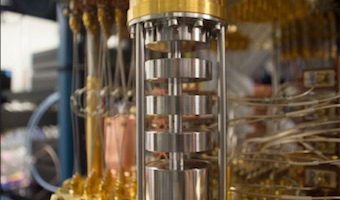 Last month, IBM announced they have constructed a 50-Qubit quantum computer prototype.
IBM has also released 20-Qubit quantum computers for customer use and plans to offer the new 50-Qubit computers to customers in the future.
Comments?
Picture Credit(s): Quantum Leap Supercomputer, IBM What is Quantum Computing Website
QASM control flow, Open Quantum Assembly Language, by A. Cross, et al.
IBM’s newly revealed 50-Qubit Quantum Processer …, Softcares blog post

 Attended SC17 last month in Denver and Nvidia had almost as big a presence as Intel. Their VR display was very nice as compared to some of the others at the show.
 GPU’s were originally designed to support visualization and the computation to render a specific scene quickly and efficiently. In order to do this they were designed with 100s to now 1000s of arithmetically intensive (floating point) compute engines where each engine could be given an individual pixel or segment of an image and compute all the light rays and visual aspects pertinent to that scene in a very short amount of time. This created a quick and efficient multi-core engine to render textures and map polygons of an image.
 Image rendering required highly parallel computations and as such more compute engines meant faster scene throughput. This led to todays GPUs that have 1000s of cores. In contrast, standard microprocessor CPUs have 10-60 compute cores today.
 Read an article today in Bitcoin magazine
 Blockchain data is inherently widely available and distributed, in fact, blockchain data needs to be widely distributed in order to work properly.
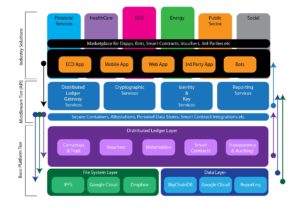
 The ixo Protocol is a method to manage (SDG) Impact projects. It starts with 3 main participants: funding agencies, service agents and evaluation agents.
 The
The