AGI, SuperIntelligence and “The Last Man”

Nietzsche wrote about the last man in Thus Spoke Zarathustra (see Last Man wikipedia article). There’s much to dislike about Nietzsche’s writing but every once in a while there are gems to be found. (Sorry for the sexist statement, it’s not me, blame Nietzsche).

It Zarathustra, Nietzsche talks of the Last Man in contempt. They no longer struggle in their daily life. They no longer create. They have an easy life filled with leisure and entertainment and no work to speak of.

From AGI to SUperIntelligence

I’ve discussed AGI many times before (I think we are up to AGI part 12, this would be part 13 and ASI (Artificial SuperIntelligence) part 3, this would be 4. But I’m thinking numbering them is not helping anymore). How to get there. the existential risk getting there. and many other facets of the risks and rewards of AGI. (Ok less on the rewards…).

I’ve also discussed Artificial SuperIntelligence (ASI). This is what we believe can be attained after AGI. If one were to use AGI to improve AI training algorithms, AI hardware, AI inferencing and use AGI to generate massive amounts of new scientific research/political research/economic research, etc. One could use the new data, the better training, inferencing, and AI hardware to create as ASI agent.

The big debate in the industry is how fast can one go from AGI to ASI. I don’t believe there’s any debate in the industry that SuperIntelligence can be obtained eventually.

There are those that believe

  • it will take many 3-5-10(?) years to attain SuperIntelligence because of all the infrastructure that has to be put in place to create current LLMs, and the view that AGI will need much more. Thus, build out is years away. If that’s the case it will take more years of infrastructural production, acquisition and data center build out to be ready to train SuperIntelligence after attaining AGI.
  • It will take just a few years 1-2-3(?) to achieve SuperIntelligence after AGI. This is because, one could use AGI to improve the AI training & inferencing algorithms and drastically increase the utilization of current AI hardware, such that there may be no need for any additional hardware to reach SuperIntelligence. Then the prime determinant of the time it takes to achieve SuperIntelligence is how fast AGI(s) can generate new scientific, medical, sociological, etc. research needed to train SuperIntelligence .

Yes, much scientific, et al research requires experimentation in the real world, (although much can now be done in simulation). But even physical experimentation is being rapidly automated today.

So the time it takes to generate sufficient research to create enough data to train an ASI may be very short. Just consider how fast LLM agents can generate code today to get a feel for what they could do tomorrow for research.

Maybe regulatory bodies could slow this down. But my bet would be that regulatory artifices would turn out to be ineffectual. At best they will drive AGI-ASI training/deployment activity underground which may delay it a couple of years while organizations build up the AI training infrastructure in hiding.

The one serious bottleneck may be AI data center’s power requirements. But if rogue states can build centrifuges to enrich radioactive materials, intercontinental missiles, biological warfare agents, etc., they can certainly steal/buy/find a way to duplicate AI data center infrastructure components.

Regulatory regimens, at worst, would completely ignored by state actors and all large commercial enterprises. The first mover advantages of AGI and ASI are too large for any organization to ignore.

What happens when SuperIntelligence is reached

I see one of two possibilities for how the achievement of AGI and SuperIntelligence plays out, with respect to humanity

  • Humankind Utopia – AGI & ASI agents can do anything that humans can do and do it better, faster, and more efficiently. The question remains what would be left for humanity to do when this is reached. Alright, at the moment, LLM agents are mostly limited to working in the digital domain. But with robotics coming online over the next decade, this will change to add more real world domains to whatever AGI-ASI agents can do.
  • Humankind Hell – AGI & ASI agents determine that humanity is a pestilence to the Earth and starts to cut them back to something that’s less consumptive of Earth resources. Again, although AI agents are restricted to the digital domain today, that won’t last for long, especially as AGI & ASI agents go live. So robots with ASI agents will be the worst aggressor in the history of the world and with the tools at their disposal, they could easily create biological, chemical and other weapons of mass destruction to deploy against humanity.

SuperIntelligence risk and rewards

It’s been obvious to me, SciFi authors and some select AI researchers that there is a sizable risk that a SuperIntelligence, once unleashed, will eliminate, severely restrict or enslave humanity resulting in Humanity’s Hell.

On the other extreme are many corporate CEO/CTOs and other AI researchers which believe that SuperIntelligence will be a Godsend to humankind. Once it arrives and is deployed, humanity will no longer have to do any work it does not want to do. All work will be handed off to robots and their ASI agents which will perform it at greater speed, with higher quality and with lower cost than can be conceivable done today.

What seems to be happening today with current AI agents is that some white collar work is becoming easier to perform, if not totally eliminated. CEO’s see this as an opportunity to reduce workforce size. For example, some CEOs are eliminating HR organizations with the belief that LLM chatbots together with a much smaller group can handle this all of what HR was doing before.

And of course as AI agents become more sophisticated this will ensure more workforce reductions. And once AI agents are embodied in robotics, blue collar workforce will also be at risk.

Human Utopia and “The Last Man”

Nietzsche’s was writing in the late 1800s when technology and automation were just starting to make a difference in the world of work. But the industrial revolution was in full steam and had already had significant impact on the work force.

Nietzsche believed that further industrialization, it continued (which of course it has), would result in the Last Man.

The Last Man is at the point where technology and automation has taken over all tasks, trades and work, and where the Last Man has no real duties they need to perform other than consume goods and services provided by automation. For the Last Man, wealthy or poor no longer have any consequences, as they can have anything they could possibly desire.

To Nietzsche, the Last Man is an anathema. He believes that true humanity requires struggle, striving and advancement. Once the Last Man is achieved all these will no longer matter, no longer be a part of humanities existence and no longer impact one’s lifestyle.

When humanity no longer has to struggle, strive and advance, humanity will lose the very essence that makes humanity human. We will, over time, lose the ability and desire to do any of that, as it all becomes the purview of AGI-ASI.

The Last Man is coming already

Example 1: Ethiopian Flight 409 2010 disaster (see wikipedia article) is one example in a very technical domain. As I understand it, the flight was enroute to France when it went into a stall, the pilots did the wrong thing to get out of it and they spiraled into the sea.

The pilot was the most experienced pilot in the airline (logged over 10K flight hrs). The co-pilot was much less experienced. Getting out of a “stall” is rudimentary to flying. In fact, exiting a stall is one of the important skills taught to all pilots and in fact, they need to demonstrate they can get out of a stall before they get their pilot licenses.

The “problem” had been brewing for a while. Ever since aircraft auto-pilots came into service, real live pilots did less and less real flying of airplanes. As a result, these two pilots forgot how to get out of a stall and it caused the accident.

Example 2: Self-driving technology has been rapidly improving over the last decade or so. We often become dependent on its capabilities and when there’s some sort of failure it can be disastrous because we have lost many of our most important driving skills.

In my case, we have a relatively dumb car with what they call “”smart cruise control”. You can set it to a speed and the vehicle will retain that speed unless a vehicle in front of you is going slower, then it will slow down to maintain some set distance behind that vehicle.

We were driving along and a truck cut into our lane. This truck had a very high backend profile with no structures where normal vehicles would protrude until you got to its tires. Well the smart cruise control didn’t detect its existence until we were almost underneath the truck bed. We tried to brake but it took too many seconds to get that done and in the end we had to go off the road to save ourselves. We had lost our emergency braking skills and situational awareness skills. Nowadays we don’t drive with cruise control on as much.

A multitude of examples exist that show AI and automation has led to humans becoming less skilled at some activity. And when AI automation doesn’t work properly, bad things happen, because we no longer know how to react properly.

The Last Man, here today, gone tomorrow.

So imagine a life where you are born with everything you could possible need to succeed. You are educated by the very best automated personal tutors. You are provided an (Amazon and Walmart) X 1000, with unlimited credit. You grow up with everyone else having just the same life as you because all of you have no work to do and have infinite sums and have infinite products to consume.

Life in such a utopia would from some perspective be almost Godlike. But if you take the perspective that humanity needs struggle, needs challenges, needs to strive to better themselves at every stage, such a life would be a disaster.

And that’s what Humanity’s Utopia would look like. Definitely better than Humanity’s Hell but in the end, not sure the difference matters as much.

~~~

I just don’t really see any path forward that’s good for humanity where AGI and SuperIntelligence exists.

Stopping AI development here today, seems idiotic, going where we seem to be going seems insane.

Comments?

Picture Credit(s):

Project Gemini at Cloud Field Day 20 #CFD20

At AIFD4 Google demonstrated Gemini 1.0 writing some code for a task that someone had. At CFD20 Google Lisa Shen demonstrated how easy it is to build a LLM-RAG from scratch using GCP Cloud Run and VertexAI APIs. (At press time, the CFD20 videos from GCP were not available but I am assured they will be up there shortly)

I swear in a matter of minutes Lisa Shen showed us two Python modules (indexer.py and server.py) that were less than 100 LOC each. One ingested Cloud Run release notes (309 if I remember correctly), ran embeddings on them and created a RAG Vector database with the embedded information. This took a matter of seconds to run (much longer to explain).

And the other created an HTTP service that opened a prompt window, took the prompt, embedded the text, searched the RAG DB with this and then sent the original prompt and the RAG reply to the embedded search to a VertexAI LLM API call to generate a response and displayed that as an HTTP text response.

Once the service was running, Lisa used it to answer a question about when a particular VPC networking service was released. I asked her to ask it to explain what that particular networking service was. She said that it’s unlikely to be in the release notes, but entered the question anyways and lo and behold it replied with a one sentence description of the networking capability.

GCP Cloud Run can do a number of things besides HTTP services but this was pretty impressive all the same. And remember that GCP Cloud Run is server less, so it doesn’t cost a thing while idle and only incurs costs something when used.

I think if we ask nicely Lisa would be willing to upload her code to GitHub (if she hasn’t already done that) so we can all have a place to start.

~~~~

Ok all you enterprise AI coders out there, start your engines. If Lisa can do it in minutes, it should take the rest of us maybe an hour or so.

My understanding is that Gemini 2.0 PRO has 1M token context. So the reply from your RAG DB plus any prompt text would need to be under 1M tokens. 1M tokens could represent 50-100K LOC for example, so there’s plenty of space to add corporate/organizations context.

There are smaller/cheaper variants of Gemini which support less tokens. So if you could get by with say 32K Tokens you might be able to use the cheapest version of Gemini (this is what the VertexAI LLM api call ends up using).

Also for the brave at heart wanting some hints as to what come’s next, I would suggest watching Neama Dadkhanikoo’s session at CFD20 with a video on Google DeepMind’s Project Astra. Just mind blowing.

Comments?

Towards a better AGI – part 3(ish)

Read an article this past week in Nature about the need for Cooperative AI (Cooperative AI: machines must learn to find common ground) which supplies the best view I’ve seen as to a direction research needs to go to develop a more beneficial and benign AI-AGI.

Not sure why, but this past month or so, I’ve been on an AGI fueled frenzy (at leastihere). I didn’t realize this was going to be a multi-part journey otherwise, I would have lableled them AGI part-1 & -2 ( please see: Existential event risks [part-0], NVIDIA Triton GMI, a step to far [part-1] and The Myth of AGI [part-2] to learn more).

But first please take our new poll:

The Nature article puts into perspective what we all want from future AI (or AGI). That is,

  • AI-AI cooperation: AI systems that cooperate with one another while at the same time understand that not all activities are zero sum competitions (like chess, go, Atari games) but rather most activities, within the human sphere, are cooperative activities where one agent has a set of goals and a different agent has another set of goals, some of which overlap while others are in conflict. Sport games like soccer lacrosse come to mind. But there are other card and (Risk & Diplomacy) board games that use cooperating parties, with diverse goals to achieve common ends.
  • AI-Human cooperation: AI systems that cooperate with humans to achieve common goals. Here too, most humans have their own sets of goals, some of which may be in conflict with the AI systems goals. However, all humans have a shared set of goals, preservation of life comes to mind. It’s in this arena where the challenges are most acute for AI systems. Divining human and their own system underlying goals and motivations is not simple. And of course giving priority to the “right” goals when they compete or are in conflict will be an increasingly difficult task to accomplish, given todays human diversity.
  • Human-Human cooperation: Here it gets pretty interesting, but the paper seems to say that any future AI system should be designed to enhance human-human interaction, not deter or interfere with it. One can see the challenge of disinformation today and how wonderful it would be to have some AI agent that could filter all this and present a proper picture of our world. But, humans have different goals and trying to figure out what they are and which are common and thereby something to be enhanced will be an ongoing challenge.

The problem with today’s AI research is that its all about improving specific activities (image recognition, language understanding, recommendation engines, etc) but all are point solutions and none (if any) are focused on cooperation.

Tit for tat wins the award

To that end, the authors of the paper call for a new direction one that attempts to imbue AI systems with social intelligence and cooperative intelligence to work well in the broader, human dominated world that lies ahead.

In the Nature article they mentioned a 1984 book by Richard Axelrod, The Evolution of Cooperation. Perhaps, the last great research on cooperation that was ever produced.

In this book it talked about a world full of simulated prisoner dilemma actors that interacted, one with another, at random.

The experimenters programmed some agents to always do the proper thing for their current partner, some to always do the wrong thing to their partner, others to do right once than wrong from that point forward, etc. The experimenters tried every sort of cooperation policy they could think of.

Each agent in an interaction would get some number of points for an interaction. For example, if both did the right thing they would each get 3 points, if one did wrong, the sucker would get 1 and the bad actor would get 4, both did wrong each got 1 point, etc.

The agents that had the best score during a run (of 1000s of random pairings/interactions) would multiply for the the next run and the agents that did worse would disappear over time in the population of agents in simulated worlds.

The optimal strategy that emerged from these experiments was

  1. Do the right thing once with every new partner, and
  2. From that point forward tit for tat (if the other party did right the last time, then you do right thing the next time you interact with them, if they did wrong the last time, then you do wrong the next time you interact with them).

It was mind boggling at the time to realize that such a simple strategy could be so effective/sustainable in simulation and perhaps in the real world. It turns out that in a (simulated) world of bad agents, there would be this group of Tit for Tat agents that would build up, defend itself and expand over time to succeed.

That was the state of the art in cooperation research back then (1984). I’ve not seen anything similar to this since.

I haven’t seen anything like this that discusses how to implement algorithms in support of social intelligence.

~~~~

The authors of the Nature article believe it’s once again time to start researching cooperation techniques and start researching social intelligence so we can instill proper cooperation and social intelligence technology into future AI (AGI) systems .

Perhaps if we can do this, we may create a better AI (or AGI) so that both it and we can live better in our world, galaxy and universe.

Comments?

An Open Source Powered Leg

I read an article a couple of weeks back about an Open Source Bionic Leg, which was reporting on research began as a NSF funded project at the University of Michigan (UoM), with collaboration from Northwestern, University of Texas at Dallas and CMU. UofM has a website that provides everything you need to build your own open source leg (OSL) leg at OpenSourceLeg.com.

The challenge in human prosthetics these days is that all research is done in silos. Much of it is proprietary and only available within corporations but even university research has been hampered by the lack of a standard platform that could be used to develop new components and ideas on.

The real difficulty is defining the control logic (code). The OSL project is intended to resolve this lack of a platform by providing everything a researcher (hobbyist, or amputee) needs to build their own, at home or in the lab.

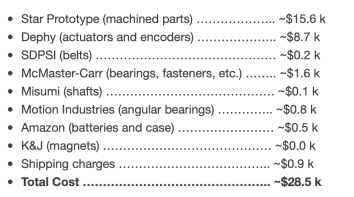
The website includes a parts lists and STEP files as well as an estimated cost ($28.5K) to build your own powered prosthetic leg. They also have a Excel spread sheet with all the parts listed, including part numbers and links to where they can be ordered (McMaster-Carr, SolidWorks, & Dephy)

They also show how to build a leg with a short youtube video of how to assemble the whole leg as well as details for each subassembly with separate how-to videos for each.

The open source leg makes use of code from FlexSEA (Flexible Scaleable Electronics Architecture) and Dephy. FlexSea was originally developed by Jean-Francois (JF) Duval while he was at MIT for his doctoral thesis. He has since joined Dephy a robotics design firm. The open source leg project uses FlexSea/Dephy code for its servo control mechanisms.

There is a GitHub Python, MatLab and C control library repo with all the code. The open source leg website also includes instructions, scripts and an image file which can be used to build your own RaspberryPi (4) controller for the leg.

The two (ankle and knee) servos are USB connected to the RPi. There are also other sensors such as the joint (servo-motor) encoders and a six axis load sensor I2C connected to the RPi. Each servo has its own 950mAh battery.

On the OSL website’s control page one can see these servos in action (with short youtube segments). They also provide instructions on how to use the open source control library to take the servo mechanisms through their paces.

Although on the OSL website’s control page I didn’t see anything which put the whole leg together to make use of it in a real world application. They did show on the Data page a youtube video with the OSL attached to a person and being used to walk up and down stairs, inclines and walking across a floor.

~~~~

Seeing as how the OSL website included STEP and PDF files for all the (machined) parts which represent $15.6K of the $28.5K, if one really wanted to do this on the cheap, one could just 3D print these parts in plastic. It would obviously not suffice mechanically for real use, but it could provide a platform for testing and developing control logic. At some point one could upgrade some or all of the plastic 3D printed parts to something more durable for use in human trials.

Another option is to purchase multiple sets of parts. The OSL website also showed price estimates for purchasing two sets of ankle and knee parts. But I’d imagine if one was so inclined, a number of researchers (hobbyists or amputees) could get together and order multiple sets of parts for reduced prices.

It’s also possible, with a lot of work, that the open source leg could be redesigned to support an open source arm-hand mechanism. This is where having 3D printed plastic parts could be extremely useful in helping to redesign the leg into an arm-hand.

Photo Credit(s):

Internet of Tires

Read an article a couple of weeks back (An internet of tires?… IEEE Spectrum) and can’t seem to get it out of my head. Pirelli, a European tire manufacturer was demonstrating a smart tire or as they call it, their new Cyber Tyre.

The Cyber Tyre includes accelerometer(s) in its rubber, that can be used to sense the pavement/road surface conditions. Cyber Tyre can communicate surface conditions to the car and using the car’s 5G, to other cars (of same make) to tell them of problems with surface adhesion (hydroplaning, ice, other traction issues).

Presumably the accelerometers in the Cyber Tyre measure acceleration changes of individual tires as they rotate. Any rapid acceleration change, could potentially be used to determine whether the car has lost traction due and why.

They tested the new tires out at a (1/3rd mile) test track on top of a Fiat factory, using Audi A8 automobiles and 5G. Unclear why this had to wait for 5G but it’s possible that using 5G, the Cyber Tyre and the car could possibly log and transmit such information back to the manufacturer of the car or tire.

Accelerometers have become dirt cheap over the last decade as smart phones have taken off. So, it was only a matter of time before they found use in new and interesting applications and the Cyber Tyre is just the latest.

Internet of Vehicles

Presumably the car, with Cyber Tyres on it, communicates road hazard information to other cars using 5G and vehicle to vehicle (V2V) communication protocols or perhaps to municipal or state authorities. This way highway signage could display hazardous conditions ahead.

Audi has a website devoted to Car to X communications which has embedded certain Audi vehicles (A4, A5 & Q7), with cellular communications, cameras and other sensors used to identify (recognize) signage, hazards, and other information and communicate this data to other Audi vehicles. This way owning an Audi, would plug you into this information flow.

Pirelli’s Cyber Car Concept

Prior to the Cyber Tyre, Pirelli introduced a Cyber Car concept that is supposedly rolling out this year. This version has tyres with real time pressure, temperature, (static) vertical load and a Tyre ID. Pirelli has been working with car manufacturers to roll out Cyber Car functionality.

The Tyre ID seems to be a file that can include anything that the tyre or automobile manufacturer wants. It sort of reminds me of a blockchain data blocks that could be used to validate tyre manufacturing provenance.

The vertical load sensor seems more important to car and tire manufacturers than consumers. But for electrical car owners, knowing car weight could help determine current battery load and thereby more precisely know how much charge is left in a battery.

Pirelli uses a proprietary algorithm to determine tread wear. This makes use of the other tyre sensors to predict wear and perhaps uses an AI DL algorithm to do this.

~~~

ABS has been around for decades now and tire pressure sensors for over 10 years or so. My latest car has enough sensors to pretty much drive itself on the highway but not quite park itself as of yet. So it was only a matter of time before something like smart tires would show up.

But given their integration with car electronics systems, it would seem that this would only make sense for new cars that included a full set of Cyber Tyres. That is until all tire AND car manufacturers agreed to come up with a standard protocol to communicate such information. When that happens, consumers could chose any tire manufacturer and obtain have similar if not the same functionality from them.

I suppose someone had to be first to identify just what could be done with the electronics available today. Pirelli just happens to be it for now in the tire industry.

I just don’t want to have to upgrade tires every 24 months. And, if I have to wait a long time for my car to boot up and establish communications with my tires, I may just take a (dumb) bike.

Photo Credit(s):

Clouds an existential threat – part 2

Recall that in part 1, we discussed most of the threats posed by clouds to both hardware and software IT vendors. In that post we talked about some of the more common ways that vendors are trying to head off this threat (for now).

In this post we want to talk about some uncommon ways to deal with the coming cloud apocalypse.

But first just to put the cloud threat in perspective, the IT TAM is estimated, by one major consulting firm, to be a ~$3.8T in 2019 with a growth rate of 3.7% Y/Y. The same number for public cloud spending, is ~$214B in 2019, growing by 17.5% Y/Y. If both growth rates continue (a BIG if), public cloud services spend will constitute all (~98.7%) of IT TAM in ~24 years from now. No nobody would predict those growth rates will continue but it’s pretty evident the growth trends are going the wrong way for (non-public cloud) IT vendors.

There are probably an infinite number of ways to deal with the cloud. But outside of the common ones we discussed in part 1, only a dozen or so seem feasible to me and even less are fairly viable for present IT vendors.

  • Move to the edge and IoT.
  • Make data center as easy and cheap to use as the cloud
  • Focus on low-latency, high data throughput, and high performing work and applications
  • Move 100% into services
  • Move into robotics

The edge has legs

Probably the first one we should point out would be to start selling hardware and software to support the edge. Speaking in financial terms, the IoT/Edge market is estimated to be $754B in 2019, and growing by over a 15.4% CAGR ).

So we are talking about serious money. At the moment the edge is a very diverse environment from cameras, sensors and moveable devices. And everybody seems to be in the act, big industrial firms, small startups and everyone in between. Given this diversity it’s hard to see that IT vendors could make a decent return here. But given its great diversity, one could say it’s ripe for consolidation.

And the edge could use some reference architectures where there are devices at the extreme edge, concentrators at the edge, more higher concentrators at nodes and more at the core, etc. So there’s a look and feel to it that seems like Ro/Bo – central core hub and spoke architectures, only on steroids with leaf proliferation that can’t be stopped. And all that data coming in has to be classified, acted upon and understood.

There are plenty of other big industrial suppliers in this IoT/edge field but none seem to have the IT end of the market that Hitachi Vantara can claim to. Some sort of combination of a large IT vendor and a large industrial firm could potentially do the same

However, Hitachi Vantara seems to be focusing on the software side of the edge. This may be an artifact of Hitachi family of companies dynamics. But it seems to be leaving some potential sales on the table.

Hitachi Vantara has the advantage of being into industrial technology in a big way so the products they create operate in factories, rail yards, ship yards and other industrial sites around the world already. So, adding IoT and edge capabilities to their portfolio is a natural extension of this expertise.

There are a few vendors going into the Edge/IoT in a small way, but no one vendor personifies this approach more than Hitachi Vantara. The Hitachi family of companies has a long and varied history in OT (operational technology) or industrial technology. And over the last many years, HDS and now Hitachi Vantara, have been pivoting their organization to focus more on IoT and edge solutions and seem to have made IOT, OT and the edge, a central part of their overall strategy.

So there’s plenty of money to be made with IoT/Edge hardware and software, one just has to go after it in a big way and there’s lots of competition. But all the competition seems to be on the same playing field (unlike the public cloud playing field).

Getting to “data center as a cloud”

There are a number of reasons why customers migrate work to the cloud, ease of use, ease of storage, ease of scale, access to myriad applications, access to multi-regional data centers, CAPex financial model, to name just a few.

There’s nothing that says much of this couldn’t be provided at the data center. It’s mostly just a lot of open source software and a lot of common hardware. IT vendors can do this sort of work if they put their vast resources to go after it.

From the pure software side, there are a couple of companies trying to do this namely VMware and Nutanix but (IBM) RedHat, (Dell) Pivotal, HPE Simplivity and others are also going after this approach.

Hardware wise CI and HCI, seem to be rudimentary steps towards common hardware that’s easy to deploy, operate and support. But these baby steps aren’t enough. And delivery to deployment in weeks is never going to get them there. If Amazon can deliver books, mattresses, bicycles, etc in a couple of days. IT vendors should be able to do the same with some select set of common hardware and have it automatically deployable in seconds to minutes once powered on.

And operating these systems has to be drastically simplified. On any public cloud there’s really no tuning required, almost minimal configuration, and then it’s just load your data and go. Yes there’s a market place to select, (virtual) hardware, (virtual) storage hardware, (virtual) networking hardware, (virtual server) O/S and (virtual?) open source applications.

Yes there’s a lots of software behind all that virtualization. And it’s fundamentally different than today’s virtualized systems. It’s made to operate only on commodity hardware and only with open source software.

The CAPex financial model is less of a problem. Today. I find many vendors are offering their hardware (and some software) on a CAPex, pay as you go model. More of this needs to be made available but the IT vendors see this, and are already aggressively moving in this direction.

The clouds are not standing still what with Azure Stack, AWS and GCP all starting to provideversions of their stack on prem in the enterprise. This looks to be a strategic battleground between the clouds and IT vendors.

Making everything IT can do in the cloud available in the data center, with common hardware and software and with the speed and ease of deployment, operations and support (maintenance) should be on every IT vendors to do list.

Unfortunately, this is not going to stop the public cloud completely, but it has the potential to slow the growth rate. But time is short, momentum has moved to the public cloud and I don’t (yet) see the urgency of the IT vendors to make this transition happen today.

Focus on low-latency, high data throughput and high performance work

This is somewhat unfair as all the IT vendors are already involved in these markets in a big way. But, there are some trends here, that indicate this low-latency market will be even more important over time.

For example, more and more of commercial IT is starting to take advantage of big data and AI to profit from all their data. And big science is starting to migrate to IT, where massive data flows and data analysis tools are becoming important to the data center. If anything, the emergence of IoT and the edge will increase data flows that need to be analyzed, understood, and ultimately dealt with.

DNA genomics may be relegated to big pharma/medical but 3D visualization is becoming so mainstream that I can do it on my desktop. These sorts of things were relegated to HPC/big science just a decade or so ago. What tools exist in HPC today that the IT data center of the future will deam a necessary part of their application workload.

Is this a sizable TAM, probably not today. In all honesty it’s buried somewhere in the IT TAM above. But it can be a growing niche, where IT vendors can stake a defensive position and the cloud may have a tough time dislodging.

I say the cloud “may have trouble dislodging” because nothing says that the entire data flow/work flow couldn’t migrate to the cloud, if the responsiveness was available there. But, if anything (guaranteed) responsiveness is one of the few achilles heels of the public cloud. Security may be the other one.

We see IBM, Intel, and a few others taking this space seriously. But all IT vendors need to see where they can do better here.

Focus on services

This not really out-of-box thinking. Some (old) IT vendors have been moving into services for over 50 years now others are just seeing there’s money to be made here. Just about every IT vendor has deployment & support services. most hardware have break-fix services.

But standalone IT services are more specialized and in the coming cloud apocalypse, services will revolve around implementing cloud applications and functionality or migrating work from the cloud or (rarely in the future) back to on prem.

TAM for services is buried in the total IT spend but industry analysts estimate that in 2019 total worldwide TAM for IT services will be about $1.0 in 2019 and growing by 2.6% CAGR.

So services are already a significant portion of IT spend today. And will probably not be impacted by the move to the cloud. I’d say that because implementing applications and services will still exist as long as the cloud exists. Yes it may get simpler (better frameworks, containerization, systemization), but it won’t ever go away completely.

Robots, the endgame

Ok laugh now. I understand this is a big ask to think that Robot spending could supplement and maybe someday surpass IT spending. But we all have to think long term. What is a self driving car but a robotic data center on wheels, generating TB of data every day it’s driven.

Robots over the next century will invade every space, become ever present and ever necessary to modern world functioning . They will have sophisticated onboard computing, motors, servos, sensors and on board and backend processing requirements. The real low-latency workload of the future will be in the (computing) minds of robots.

Even if the data center moves entirely to the cloud, all robotic computation will never reside there because A) it’s too real time and B) it needs to operate well even disconnected from the Internet.

Is all this going to happen in the next 10 or 20 years, maybe not but 30 to 50 years out this world will have a multitude of robots operating within it. .

Who’s going to develop, manufacture, support and sustain these mobile computing data centers on wheels, legs, slithering and flying bodies?

I would say IT vendors of today are uniquely positioned to dominate this market. Here to the industry is very fragmented today. There are a few industrial robotic companies and just about every major auto manufacturer is going after self driving cars. And there are many bit players today. So it’s ripe for disruption and consolidation. .

Yet, none of the major IT vendors seem to be going after this. Ok Amazon (hardware & software) and Microsoft (software) have done work in this arena. If anything this should tell IT vendors that they need to start working here as well.

But alas, none have taken up the mantle. In the mean time robot startups are biting the dust left and right, trying to gain market traction.

~~~~

That seems to be about it for the major viable out of the box approaches to the public cloud threat. I have a few other ideas but none seem as useful as the above.

Let me know what you think.

Picture credit(s):

Are neuromorphic chips a dead end? – Neuromorphic Part 5

Read a recent article about Intel’s Pohoiki Beach neuromorphic system and their Loihi chips, that has scaled up to 8M neurons in IEEE Spectrum (Intel’s neuromorphic system hits 8 M neurons). In the last month or so I wrote up about a two startups one of which seemed (?) to be working on a neuromorphic chip development (see my Photonics computing sees the light of day post).

But first please take our new poll:

I’ve been writing about neuromorphic chips since 2011, 8 long years (see IBM SyNAPSE chip post from 2011 or search my site for “neuromorphic”) and none have been successfully reached the market. The problems with neurmorphic architectures have always been twofold, scaling AND software.

Scaling up neurons

The human brain has ~86B neurons (see wikipedia human brain article). So, 8 million neuromorphic neurons is great, but it’s about 10K X too few. And that doesn’t count the connections between neurons. Some human neurons have over 1000 connections between nerve cells (can’t seem to find this reference anymore?).

Wikimedia commons (481px-Chemical_synapse_schema_cropped)

To get from a single chip with 125K neurons to their 8M neuron system, Intel took 64 chips and put them on a couple of boards. To scale that to 86B or so would take ~690, 000 of their neuromorphic chips. Now, no one can say if there’s not some level below 85B neuromorphic neurons, that could support a useful AI solution, but the scaling problem still exists.

Then there’s the synapse connections between neuromorphic neurons problem. The article says that Loihi chips are connected in a heirarchical routing network, which implies to me that there are switches and master switches (and maybe a really big master switch) in their 8M neuromorphic neuron system. Adding another 4 orders of magnitude more neuromorphic neurons to this may be impossible or at least may require another 4 sets of progressively larger switches to be added to their interconnect network. There’s a question of how many hops and the resultant latency in connecting two neuromorphic neurons together but that seems to be the least of the problem with neuromorphic architectures.

Missing software abstractions

The first time I heard about neuromorphic chips I asked what the software looks like and the only thing I heard was that it was complex and not very user friendly and they didn’t want to talk about it.

I keep asking about software for neuromorphic chips and still haven’t gotten a decent answer. So, what’s the problem. In today’s day and age, software is easy to do, relatively inexpensive to produce and can range from spaghetti code to a hierarchical masterpieces, so there’s plenty of room to innovate here.

But whenever I talk to engineers about what the software looks like, it almost seems like a software version of an early plug board unit-record computer (essentially card sorters). Only instead of wires, you have software neuromorphic network connections and instead of electro-magnetic devices, one has software spiking neuromorphic neuron hardware.

The way we left plugboards behind was by building up hardware abstractions such as adders, shifters, multipliers, etc. and moving away from punch cards as a storage medium. Somewhere along this transition, we created programing languages like (macro) Assemblers, COBOL, FORTRAN, LISP, etc. It’s the software languages that brought computing out of the labs and into the market.

It’s been at least 8 years now, and yet, no-one has built a spiking neuromorphic computer language yet. Why not?

I think the problem is there’s no level of abstraction above a neuron. Where’s the aritmetic logic unit (ALU) or register equivalents in neuromorphic computers? They don’t exist as far as I can see.

Until we can come up with some higher levels of abstraction, coding neuromorphic chips is going to be an engineering problem not a commercial endeavor.

But neuromorphism has advantages

The IEEE article states a couple of advantages for neuromorphic computing: less energy to perform inferencing (and possibly training) and the ability to train on incremental data rather than having to train across whole datasets again.

Yes these are great, but there’s a gaggle of startups (e.g., see New GraphCore GC2 chip…, AI processing at the edge, TPU and HW-SW innovation) going after the energy problem in AI DL using Von Neumann architectures.

And the incremental training issue doesn’t seem any easier when you have ~80B neurons, with an occasional 1000s of connections between them to adjust correctly. From my perspective, its training advantage seems illusory at best.

Another advantage of neuromorphism is that it simulates the real analog logic of a human brain. Again, that’s great but a brain takes ~22 years to train (college level). Maybe because neuromorphic chips are electronic perhaps training can be done 100 times faster. But there’s still the software issue

~~~~

I hate to be the bearer of bad news. There’s been some major R&D spend on neuromorphism and it continues today with no abatement.

I just think we’d all be better served figuring out how to program the beast than on –spending more to develop more chip hardware..

This is hard for me to say, as I have always been a proponent of hardware innovation. It’s just that neuromorphic software tools don’t exist yet. And I’m afraid, I don’t see any easy way forward to make any progress on this.

Comments?.

Picture credit(s):

Quantum computer programming

I was on a vendor call last week and they were discussing their recent technological advances in quantum computing. During the discussion they mentioned a number of ways to code for quantum computers. The currently most popular one is based on the QIS (Quantum Information Software) Kit.

I went looking for a principle of operations on quantum computers. Ssomething akin to the System 360 Principles of Operations Manual that explained how to code for an IBM 360 computer. But there was no such manual.

Instead there is a paper, on the Open Quantum Assembly Language (QASM) that describes the Quantum computational environment and coding language used in QIS Kit.

It appears that quantum computers can be considered a special computational co-proccesor engine, operated in parallel with normal digital computation. This co-processor happens to provide a quantum simulation.

QASM coding

One programs a quantum computer by creating a digital program which describes a quantum circuit that uses qubits and quantum registers to perform some algorithm on those circuits. The quantum circuit can be measured to provide a result  which more digital code can interpret and potentially use to create other quantum circuits in a sort of loop.

There are four phases during the processing of a QIS Kit quantum algorithm.

  1. QASM compilation which occurs solely on a digital computer. QASM source code describing the quantum circuit together with compile time parameters are translated into a quantum PLUS digital intermediate representation.
  2. Circuit generation, which also occurs on a digital computer with access to the quantum co-processor. The intermediate language compiled above is combined with other parameters (available from the quantum computer environment) and together these are translated into specific quantum building blocks (circuits) and some classical digital code needed and used during quantum circuit execution.
  3. Execution, which takes place solely on the quantum computer. The system takes as input, the collection of quantum circuits defined above and runtime control parameters,and transforms these using a high-level quantum computer controller into low-level, real time instructions for the quantum computer building the quantum circuits. These are then executed and the results of the quantum circuit(s) execution creates a result stream (measurements) that can be passed back to the digital program for further  processing
  4. Post-Processing, which takes place on a digital computer and uses the results from the quantum circuit(s) execution and other intermediate results and processes these to either generate follow-on quantum circuits or output ae final result for the quantum algorithm.

As qubit coherence only last for a short while, so results from one execution of a quantum circuit cannot be passed directly to another execution of quantum circuits.  Thus these results have to be passed through some digital computations before they can be used in subsequent quantum circuits. A qubit is a quantum bit.

Quantum circuits don’t offer any branching as such.

Quantum circuits

The only storage for QASM are classical (digital) registers (creg) and quantum registers (qreg) which are an array of bits and qubits respectively.

There are limited number of built-in quantum operations that can be performed on qregs and qubits. One described in the QASM paper noted above is the CNOT   operation, which flips a qubit, i.e., CNOT alb will flip a qubit in b, iff a corresponding qubit in a is on.

Quantum circuits are made up of one or more gate(s). Gates are invoked with a set of variable parameter names and quantum arguments (qargs). QASM gates can be construed as macros that are expanded at runtime. Gates are essentially lists of unitary quantum subroutines (other gate invocations), builtin quantum functions or barrier statements that are executed in sequence and operate on the input quantum argument (qargs) used in the gate invocation.

Opaque gates are quantum gates whose circuits (code) have yet to be defined. Opaque gates have a physical implementation may yet be possible but whose definition is undefined. Essentially these operate as place holders to be defined in a subsequent circuit execution or perhaps something the quantum circuit creates in real time depending on gate execution (not really sure how this would work).

In addition to builtin quantum operations,  there are other statements like the measure  or  reset statement. The reset statement sets a qubit or qreg qubits to 0. The measure statement copies the state of a qubit or qreg into a digital bit or creg (digital register).

There is one conditional command in QASM, the If statement. The if statement can compare a creg against an integer and if equal execute a quantum operation. There is one “decision”  creg, used as an integer.  By using IF statements one can essentially construct a case statement in normal coding logic to execute quantum (circuits) blocks.

Quantum logic within a gate can be optimized during the compilation phase so that they may not be executed (e.g., if the same operation occurs twice in a gate, normally the 2nd execution would be optimized out) unless a barrier statement is encountered which prevents optimization.

Quantum computer cloud

In 2016, IBM started offering quantum computers in its BlueMix cloud through the IBM Quantum (Q)  Experience. The IBM Q Experience currently allows researchers access to 5- and 16-qubit quantum computers.

There are three pools of quantum computers: 1 pool called IBMQX5, consists of 8 16-qubit computers and 2 pools of 5 5-qubit computers, IBMQX2 and IBMQX4. As I’m writing this, IBMQX5 and IBMQX2 are offline for maintenance but IBMQX4 is active.

Google has recently released the OpenFermion as open source, which is another software development kit for quantum computation (will review this in another post). Although Google also seems to have quantum computers and has provided researchers access to them, I couldn’t find much documentation on their quantum computers.

Two other companies are working on quantum computation: D-Wave Systems and Rigetti Computing. Rigetti has their Forest 1.0 quantum computing full stack programming and execution environment but I couldn’t easily find anything on D-Wave Systems programming environment.

Last month, IBM announced they have  constructed a 50-Qubit quantum computer prototype.

IBM has also released 20-Qubit quantum computers for customer use and plans to offer the new 50-Qubit computers to customers in the future.

Comments?

Picture Credit(s): Quantum Leap Supercomputer,  IBM What is Quantum Computing Website

QASM control flow, Open Quantum Assembly Language, by A. Cross, et al

IBM’s newly revealed 50-Qubit Quantum Processer …,  Softcares blog post