QoM1610: Will NVMe over Fabric GA in enterprise AFA by Oct’2017

NVMeNVMe over fabric (NVMeoF) was a hot topic at Flash Memory Summit last August. Facebook and others were showing off their JBOF (see my Facebook moving to JBOF post) but there were plenty of other NVMeoF offerings at the show.

NVMeoF hardware availability

When Brocade announced their Gen6 Switches they made a point of saying that both their Gen5 and Gen6 switches currently support NVMeoF protocols. In addition to Brocade’s support, in Dec 2015 Qlogic announced support for NVMeoF for select HBAs. Also, as of  July 2016, Emulex announced support for NVMeoF in their HBAs.

From an Ethernet perspective, Qlogic has a NVMe Direct NIC which supports NVMe protocol offload for iSCSI. But even without NVMe Direct, Ethernet 40GbE & 100GbE with  iWARP, RoCEv1-v2, iSCSI SER, or iSCSI RDMA all could readily support NVMeoF on Ethernet. The nice thing about NVMeoF for Ethernet is not only do you get support for iSCSI & FCoE, but CIFS/SMB and NFS as well.

InfiniBand and Omni-Path Architecture already support native RDMA, so they should already support NVMeoF.

So hardware/firmware is already available for any enterprise AFA customer to want NVMeoF for their data center storage.

NVMeoF Software

Intel claims that ~90% of the software driver functionality of NVMe is the same for NVMeoF. The primary differences between the two seem to be the NVMeoY discovery and queueing mechanisms.

There are two fabric methods that can be used to implement NVMeoF data and command transfers: capsule mode where NVMe commands and data are encapsulated in normal fabric packets or fabric dependent mode where drivers make use of native fabric memory transfer mechanisms (RDMA, …) to transfer commands and data.

12679485_245179519150700_14553389_nA (Linux) host driver for NVMeoF is currently available from Seagate. And as a result, support for NVMeoF for Linux is currently under development, and  not far from release in the next Kernel (I think). (Mellanox has a tutorial on how to compile a Linux kernel with NVMeoF driver support).

With Linux coming out, Microsoft Windows and VMware can’t be far behind. However, I could find nothing online, aside from base NVMe support, for either platform.

NVMeoF target support is another matter but with NICs/HBAs & switch hardware/firmware and drivers presently available, proprietary storage system target drivers are just a matter of time.

Boot support is a major concern. I could find no information on BIOS support for booting off of a NVMeoF AFA. Arguably, one may not need boot support for NVMeoF AFAs as they are probably not a viable target for storing App code or OS software.

From what I could tell, normal fabric multi-pathing support should work fine with NVMeoF. This should allow for HA NVMeoF storage, a critical requirement for enterprise AFA storage systems these days.

NVMeoF advantages/disadvantages

Chelsio and others have shown that NVMeoF adds ~8μsec of additional overhead beyond native NVMe SSDs, which if true would warrant implementation on all NVMe AFAs. This may or may not impact max IOPS depending on scale-ability of NVMeoF.

For instance, servers (PCIe bus hardware) typically limit the number of private NVMe SSDs to 255 or less. With an NVMeoF, one could potentially have 1000s of shared NVMe SSDs accessible to a single server. With this scale, one could have a single server attached to a scale-out NVMeoF AFA (cluster) that could supply ~4X the IOPS that a single server could perform using private NVMe storage.

Base level NVMe SSD support and protocol stacks are starting to be available for most flash vendors and operating systems such as, Linux, FreeBSD, VMware, Windows, and Solaris. If Intel’s claim of 90% common software between NVMe and NVMeoF drivers is true, then it should be a relatively easy development project to provide host NVMeoF drivers.

The need for special Ethernet hardware that supports RDMA may delay some storage vendors from implementing NVMeoF AFAs quickly. The lack of BIOS boot support may be a minor irritant in comparison.

NVMeoF forecast

AFA storage systems, as far as I can tell, are all about selling high IOPS and very-low latency IOs. It would seem that NVMeoF would offer early adopter AFA storage vendors a significant performance advantage over slower paced competition.

In previous QoM/QoW posts we have established that there are about 13 new enterprise storage systems that come out each year. Probably 80% of these will be AFA, given the current market environment.

Of the 10.4 AFA systems coming out over the next year, ~20% of these systems pride themselves on being the lowest latency solutions in the market, and thus command high margins. One would think these systems would be the first to adopt NVMeoF. But, most of these systems have their own, proprietary flash modules and do not use standard (NVMe) SSDs and can use their own proprietary interface to their proprietary flash storage. This will delay any implementation for them until they can convert their flash storage to NVMe which may take some time.

On the other hand, most (70%) of the other AFA systems, that currently use SAS/SATA SSDs, could boost their IOP counts and drastically reduce their IO  response times, by implementing NVMe SSDs and NVMeoF. But converting SAS/SATA backends to NVMe will take time and effort.

But, there are a select few (~10%) of AFA systems, that already use NVMe SSDs in their AFAs, and for these few, they would seem to have a fast track towards implementing NVMeoF. The fact that NVMeoF is supported over all fabrics and all storage interface protocols make it even easier.

Moreover, NVMeoF has been under discussion since the summer of 2015, which tells me that astute AFA vendors have already had 18+ months to develop it. With NVMeoF host drivers & hardware available since Dec. 2015, means hardware and software exist to test and validate against.

I believe that NVMeoF will be GA’d within the next 12 months by at least one enterprise AFA system. So my QoM1610 forecast for NVMeoF is YES, with a 0.83 probability.

Comments?


Hedvig storage system, Docker support & data protection that spans data centers

Hedvig003We talked with Hedvig (@HedvigInc) at Storage Field Day 10 (SFD10), a month or so ago and had a detailed deep dive into their technology. (Check out the videos of their sessions here.)

Hedvig implements a software defined storage solution that runs on X86 or ARM processors and depends on a storage proxy operating in a hypervisor host (as a VM) and storage service nodes. Their proxy and the storage services can execute as separate VMs on the same host in a hyper-converged fashion or on different nodes as a separate storage cluster with hosts doing IO to the storage cluster.

Hedvig’s management team comes from hyper-scale environments (Amazon Dynamo/Facebook Cassandra) so they have lots of experience implementing distributed software defined storage at (hyper-)scale.
Continue reading “Hedvig storage system, Docker support & data protection that spans data centers”

A tale of two AFAs: EMC DSSD D5 & Pure Storage FlashBlade

There’s been an ongoing debate in the analyst community about the advantages of software only innovation vs. hardware-software innovation (see Commodity hardware loses again and Commodity hardware always loses posts). Here is another example where two separate companies have turned to hardware innovation to take storage innovation to the next level.

DSSD D5 and FlashBlade

DSSD-d5Within the last couple of weeks, two radically different AFAs were introduced. One by perennial heavyweight EMC with their new DSSD D5 rack scale flash system and the other by relatively new comer Pure Storage with their new FlashBlade storage system.FB

These two arrays seem to be going after opposite ends of the storage market: the 5U DSSD D5 is going after both structured and unstructured data that needs ultra high speed IO access (<100µsec) times and the 4U FlashBlade going after more general purpose unstructured data. And yet the two have have many similarities at least superficially.
Continue reading “A tale of two AFAs: EMC DSSD D5 & Pure Storage FlashBlade”

Platform9, a whole new way to run OpenStack

logo-long2
At TechFieldDay 10 (TFD10), in Austin this past week we had a presentation from Platform9‘s Shirish Raghuram Co-founder and CEO and Bich Le, Co-founder and Chief Architect. Both Shirish and Bich seemed to have come from having  worked a long time at VMware and prior to that, other tech giants.

Platform9 provides a user friendly approach to running OpenStack in your data center. Their solution is a SaaS based, management portal or control plane for running compute, storage and networking infrastructure under OpenStack, the open source cloud software.

Importing running virtualization environments

If you have a current, running VMware vSphere environment, you can onboard or import portions of or all of your VMs, datastores, NSX nodes, and the rest of the vSphere cluster and have them all come up as OpenStack core compute instances, Cinder storage volumes, and use NSX as a replacement for Neutron networking nodes.

In this case, once your vSphere environment is imported, users can fire up more compute instances, terminate ones they have, allocate more Cinder volumes, etc. all from an AWS-like management portal.  It’s as close to an AWS console as I have seen.

Platform9 also works for KVM environments, that is you can import currently running KVM environments into OpenStack and run them from their portal.

Makes OpenStack, almost easy to run/use/operate

Historically, the problem with OpenStack was its user interface. Platform9 solves this problem and makes it easy to import, use, and deploy VMware and KVM environments into an OpenStack framework. Once there, users and administrators have the same level of control that AWS and Microsoft Azure users have, i.e., fire up compute instances, allocate storage volumes and attach the two together, terminate the compute activities, detach the volumes and repeat, all in your very own private cloud.

Bare metal OpenStack support too

If you don’t have a current KVM or VMware environment, Platform9 will deploy a KVM virtualization environment on bare metal servers and storage and use that for your OpenStack cloud.

Security comes from tenant attributes, certain tenants have access and control over certain compute/storage/networking instances.

Customers can also use Platform9 as a replacement for vCenter, and once deployed under OpenStack, tenants/users have control over their segments of the private cloud deployment.

It handles multiple vSphere & KVM clusters as well and can also handle mixed virtualization environments within the same OpenStack cloud.

A few things missing

The only things I found missing from the Platform9 solution was Swift Object storage support and support for Hyper-V environments.

The Platform9 team mentioned that multi-region support was scheduled to come out this week, so then your users could fire up compute and storage instances across your world wide data centers, all from a single Platform9 management portal.

Pricing for the Platform9 service is on a socket basis, with volume pricing available for larger organizations.

If you are interested in a private cloud and are considering  OpenStack in order to avoid vendor lock-in, I would find it hard not to give Platform9 a try.

While at Dell


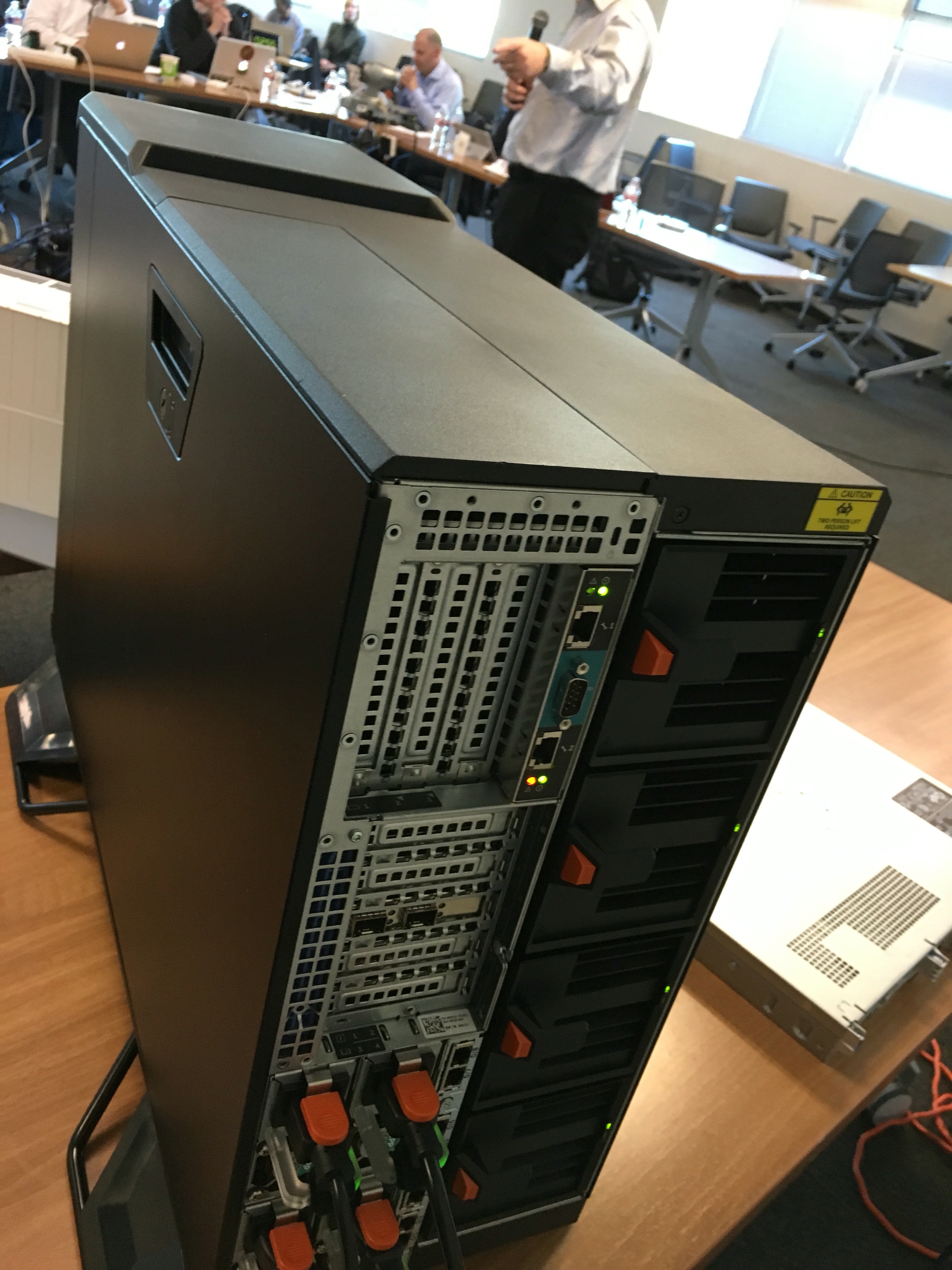
Later in the week, at TFD10 we talked with Dell, and they showed off their new VRTX Server product. Dell’s VRTX server is a very quiet, 4-server, 48TB tower or rackmount enclosure, which would make a very nice 8 or 16 socket CPU, private cloud for my home office environment (the picture doesn’t do it justice). And with a Platform9 control plane, I could offer OpenStack cloud services out of my home office, to all my neighbors around the world, for a fair but high price…

Comments?


Primary data’s path to better data storage presented at SFD8

IMG_5606rz A couple of weeks ago we met with Primary Data, Lance Smith, CEO, David Flynn, CTO and Kaycee Lai, SVP Product & Sales who were presenting at Storage Field Day 8 (SFD8, videos of their sessions available here). Primary Data has just emerged out of stealth late last year and has ~$60M in funding. Also they have Steve Wozniak (of Apple fame) as Chief Scientist, but he wasn’t at the SFD8 session 🙁

Primary Data seems out to change the world. At first I thought this was just another form of storage virtualization but they are laser focused on data virtualization or what they call data mobility. It differs from pure storage virtualization by being outside the data path.  (I have written about data virtualization before as well as the data hypervisor a long time ago). Nowadays they seem to be using the tag line of data in motion.

Why move data?

David has a theory behind the proliferation of startup storage companies. The spectrum behind capacity and performance has gotten immense, over time, which has provided an opening for a number of companies to address these widening needs.

David believes that caching at the storage system or in the servers is an attempt to address this issue by “loaning” the data from the storage silo to the cache. This is trying to supply a lower cost $/IOP for the data. Similar considerations are apparent at the other side where customer’s use archive or backup services to take advantage of much cheaper $/GB storage.

However, given the difficulty of moving data around in present day storage environments, customer data has become essentially immobile. Primary Data is trying to bring about a data mobility revolution and allow data to move over this spectrum of performance and capacity of storage with ease. Doing so easily, will provide significant benefits as customers can more fully take advantage of the various levels of performance and capacity in their data center storage environments.

Primary Data architecture

IMG_5607Primary Data is providing data mobility by using their meta-data service called the DataSphere appliance and their client software running on host servers called the Data Portal. Their offering can be best explained in three layers:

  • Data virtualization layer – provides continuity of identity and continuity of access across multiple physical storage systems. That is the same data (identity continuity) can be accessed wherever it resides (access continuity) by server applications. Such access and identity must transcend access protocols and interfaces. The Data Portal client software intercepts the server data activity and does control plane activity using the DataSphere appliance and performs IO directly using the physical storage.
  • Objective based data management – supplies a data affinity service. That is data can have a temporary location relationship with physical storage depending on the current performance (R:W, IOPS, bandwidth, latency) and protection (durability, availability, disaster recoverability, security, copy-ability, version-ability) characteristics of the data. These data objectives are matched to the capabilities or service catalog of the storage infrastructure and data objectives can change over time
  • Analytics in the loop – detects the performance and other characteristics of the storage and data in real-time. That is by monitoring the storage IO activity Primary Data can determine the actual performance attribute of the storage. Similarly, by monitoring the applications IO characteristics over time the system can determine the performance objectives of its data. The system also takes advantage of SMI-S to define some of the other characteristics of the storage systems.

How does Primary Data work?

Primary Data has taken advantage of parallel NFS extensions (pNFS) in NFSv4 to externalize and separate the storage control plane from the IO data plane. This works well for native Linux where the main developer of the Linux file system stack is on their payroll.IMG_5608rz

In Windows they put a filter driver in front of SMB to split off the control from data IO plane. Something similar is done for VMware ESX servers to supply the control-data plane split but in this case there is a software defined Data Portal that goes along with the DataSphere Service client that can do it all within the same ESX server. Another alternative exists and that is to use the Data Portal appliance as a storage virtualization service but then the IO data path goes through the portal.

According to their datasheet they currently support data virtualization services for NetApp cDOT and 7-mode, EMC Isilon OneFS7.2, and Nexenta 4.x&5.0 but plan on more.

They are not quite GA yet, but are close.

Comments?


VMware VSAN 6.0 all-flash & hybrid IO performance at SFD7

We visited with VMware’s VSAN team during last Storage Field Day (SFD7, session available here). The presentation was wide ranging but the last two segments dealt with recent changes to VSAN and at the end provided some performance results for both a hybrid VSAN and an all-Flash VSAN.

Some new features in VSAN 6.0 include:

  • More scaleability, up to 64 hosts in a cluster and up to 200VMs per host
  • New higher performance snapshots & clones
  • Rack awareness for better availability
  • Hardware based checksum for T10 DIF (data integrity feature)
  • Support for blade servers with JBODs
  • All-flash configurations
  • Higher IO performance

Even in the all-flash configuration there are two tiers of storage a write cache tier and a capacity tier of SSDs. These are configured with two different classes of SSDs (high endurance/low-capacity and low-endurance/high capacity).

At the end of the session Christos Karamanolis (@Xtosk), Principal Architect for VSAN showed us some performance charts on VSAN 6.0 hybrid and all-flash configurations.

Hybrid VSAN performance

On the chart we see two plots showing IOmeter performance as VSAN scales across multiple nodes (hosts), on the left  we have  a 100% Read workload and on the right a 70%Read:30%Write workload.

The hybrid VSAN configuration has 4-10Krpm disks and 1-400GB SSD on each host and ranges from 8 to 64 hosts. The bars on the chart show IOmeter IOPS and the line shows the average response time (or IO latency) for each VSAN host configuration. I am not a big fan of IOmeter, as it’s an overly simplified, but that’s what VMware used.

The results show that in a 100% read case the hybrid, 64 host VSAN 6.0 cluster was able to sustain ~3.8M IOPS or over 60K IOPS per host.  or the mixed 70:30 R:W workload VSAN 6.0 was able to sustain ~992K IOPs or ~15.5K IOPS per host.

We see a pretty drastic IOPs degradation (~1/4 the 100% read performance) in the plot on the right, when they added write activity to the mix. But with VSAN’s mirrored data protection each VM write represents at least two VSAN backend writes and at a 70:30 IOmeter R:W this would be ~694K IOPS read and ~298K IOPS write frontend IOs but with mirroring this represents 595K writes to the backend storage.

Then of course, there’s destage activity (data written to SSDs need  to be read off SSD and written to HDD) which also multiplies internal IO operations for every external write IOP. Lets say all that activity multiplies each external write by 6 (3 for each mirror: 1 to the write cache SSD, 1 to read it back and 1 to write to HDD) and we multiply that times the ~298K external write IOPS, it would add up to about a total of ~1.8M write derived IOPS  and ~0.7M read derived IOPS or a total of ~2.5M IOPS but this is still far away from the 3.5M IOPS for 100% read activity. I am probably missing another IO or two in the write path (maybe Virtual to physical mapping structures need to be updated) or have failed to account for more inter-cluster IO activity in support of the writes.

In addition, we see the IO latency was roughly flat across the 100% Read workload at ~2.25msec. and got slightly worse over the 70:30 R:W workload, ranging from ~2.5msec. at 4 hosts to a little over 3.0msec. with 64 hosts. Not sure why this got worse but hosts are scaled up it could induce more inter-cluster overhead.

Rays-pix37

In the chart to the right, we can see similar performance data for systems with one or two disk-groups. The message here is that with two disk groups on a host (2X the disk and SSD resources per host) one can potentially double the performance of the systems, to 116K IOPS/host on 100% read and 31K IOPS/host on a 70:30 R:W workload.

All-flash VSAN performance

Rays-pix41

Here we can see performance data for an 8-host, all-flash VSAN configuration. In this case the chart on the left was a single “disk” group and the chart on the right was a dual disk group, all-flash configuration on each of the 8-hosts. The hosts were configured with 1-400GB and 3-800GB SSDs per disk group.

The various bars on the charts represent different VM working set sizes, 100, 200, 400 & 600GB for the single disk group chart and 100, 200, 400, 800 & 1200GB for dual disk group configurations. For the dual disk group, the 1200GB working set size is much bigger than a cache tier on each host.

The chart text is a bit confusing: the title of each plot says 70% read but the text under the two plots says 100% read. I must assume these were 70:30 R:W workloads. If we just look at the 8 hosts, using a 400GB VM working set size, all-flash VSAN 6.0 single disk group cluster was able to achieve ~37.5K IOPS/host and with two disk groups, the all-flash VSAN 6.0  was able to achieve ~68.75K IOPS/host at the 400GB working set size. Both doubling the hybrid performance.

Response times degrade for both the single and dual disk groups as we increase the working set sizes. It’s pretty hard to see on the two charts but it seems to range from 1.8msec to 2.2msec for the single disk group and 1.8msec to 2.5 msec for the dual disk group. The two charts are somewhat misleading because they didn’t use the exact same working group sizes for the two performance runs but just taking the 100|200|400GB working set sizes, for the single disk group it looks like the latency went from ~1.8msec. to ~2.0msec and for the dual disk group from ~1.8msec to ~2.3msec. Why the higher degradation for the dual disk group is anyone’s guess.

The other thing that doesn’t make much sense is that as you increase the working set size the number of IOPS goes down, worse for the dual disk group than the single. Once again taking just the 100|200|400GB working group sizes this ranges from ~350K IOPS to ~300K IOPS (~15% drop) for the single disk group and ~700K IOPS to ~550K IOPS (~22% drop) for the dual disk group.

Increasing working group sizes should cause additional backend IO as the cache effectivity should be proportionately less as you increase working set size. Which I think goes a long way to explain the degradation in IOPS as you increase working set size. But I would have thought the degradation would have been a proportionally similar for both the single and dual disk groups. The fact that the dual disk group did 7% worse seems to indicate more overhead associated with dual disk groups than single disk groups or perhaps, they were running up against some host controller limits (a single controller supporting both disk groups).

~~~~

At the time (3 months ago) this was the first world-wide look at all-flash VSAN 6.0 performance. The charts are a bit more visible in the video than in my photos (?) and if you want to just see and hear Christos’s performance discussion check out ~11 minutes into the final video segment.

For more information you can also read these other SFD7 blogger posts on VMware’s session:


DDN unchains Wolfcreek, unleashes IME and updates WOS

16371098088_3b264f5844_zIt’s not every day that we get a vendor claiming 2.5X the top SPC-1 IOPS (currently held by Hitachi G1000 VSP all flash array at ~2M IOPS) as DataDirect Networks (DDN) has claimed for an all-flash version of their new Wolfcreek hyper converged appliance. DDN says their new 4U appliance is capable of 60GB/sec of throughput and over 5M IOPS. (See their press release for more information.) Unclear if these are SPC-1 IOPS or not, but I haven’t seen any SPC-1 report on it yet.

In addition to the new Wolfcreek appliance, DDN announced their new Infinite Memory Engine™ (IME) flash caching software and WOS® 360 V2.0, an enhanced version of their object storage.

DDN if you haven’t heard of them has done well in the Web 2.0 environments and is a leading supplier to high performance computing (HPC) sites. They have object storage system (WOS), all flash block storage (SFA12KXi), hybrid (disk-SSD) block storage (SFA7700X™ & SFA12KX™), Lustre file appliance (EXAScaler), IBM GPFS™ NAS appliance (GRIDScaler), media server appliance (MEDIAScaler™) and  software defined storage (Storage Fusion Accelerator [SFX™] flash caching software).

Wolfcreek hyper converged appliance

The converged solution comes in a 4U appliance using dual Haswell Intel microprocessors (with up to 18 cores each), includes a PCIe fabric which supports 48-NVMe flash cards or 72-SFF SSDs. With the NVMe or SSDs, Wolfcreek will be using their new IME software to accelerate IO activity.

Wolfcreek IME software supports either burst mode IO caching cluster or a storage cluster of nodes. I assume burst mode is a storage caching layer for backend file system stoorage. As a storage cluster I assume this would include some of their scale-out file system software on the nodes. Wolfcreek cluster interconnect is 40Gb Infiniband or 10/40Gb Ethernet and also will support Intel’s Omni-Path. The Wolfcreek appliance is compatible with HPC Lustre and IBM GPFS scale out file systems.

Wolfcreek appliance can be a great platform for OpenStack and Hadoop environments. But it also supports virtual machine hypervisors from VMware, Citrix and Microsoft. DDN says that the Wolfcreek appliance can scale up to support 100K VMs. I’ve been told that IME will not be targeted to work with Hypervisors in the first release.

Recall that with a hyper converged appliance, some portion of the system resources (memory and CPU cores) must be devoted to server and VM application activities and the remainder to storage activity. How this is divided up and whether this split is dynamic (changes over time) or static (fixed over time) in the Wolfcreek appliance is not indicated.

The hyper converged field is getting crowded of late what with VMware EVO:RAIL, Nutanix, ScaleComputing, Simplivity and others coming out with solutions. But there aren’t many that support all-flash storage and it seems unusual that hyper converged customers would have need for that much IO performance. But I could be wrong, especially for HPC customers.

There’s much more to hyper convergence than just having storage and compute in the same node. The software that links it all together, manages, monitors and deploys these combined hypervisor, storage and server systems is almost as important as any of the  hardware. There wasn’t much talk about the software that DDN is putting together for Wolfcreek but it’s still early yet. With their roots in HPC, it’s likely that any DDN hyper converged solution will target this market first and broaden out from there.

Infinite Memory Engine (IME)

IME is an outgrowth of DDN’s SFX software and seem to act as a caching layer for parallel file system IO. It makes use of NVMe or SSDs for its IO caching. And according to DDN can offer up to 1000X IO acceleration to storage or 100X file system acceleration.

It does this primarily by providing an application aware IO caching layer and supplying more effective IO to the file system layer using PCIe NVMe or SSD flash storage for hardware IO acceleration. According to the information provided by DDN, IME can provide 50 GB/sec bandwidth to a host compute cluster while only doing 4GB/sec of throughput to a backend file system, presumably by better caching of file IO.

WOS 360 V2.0

The new WOS 360 V2.0 object storage system features include

  • Higher density storage package with 98-8TB SATA drives or 768TB raw capacity in 4U) supporting 8B objects each and over 100B objects in a cluster.
  • Native SWIFT API support for OpenStack environments  which includes gateway or embedded deployments, up to 5000 concurrent users and 5B objects/namespace.
  • Global ObjectAssure data encoding with lower storage overhead (1.5x or a 20% reduction from their previous encoding option) for highly durable and available object storage usiing a two level hierarchical erasure code for object storage.
  • Enhanced network security with SSL  which provides end-to-end SSL network data transport between clients and WOS and betweenWOS storage nodes.
  • Simplified cluster installation, deployment and maintenance with can now deploy a WOS cluster in minutes, with a simple point and click GUI for installation and cluster deployment with automated non-disruptive software upgrade.
  • Performance improvements for better video streaming, content distribution and large file transfers with improved QoS for latency sensitive applications.

~~~~

Probably more going on with DDN than covered here but this hits the highlights. I wish there was more on their Wolfcreek appliance and its various configurations and performance benchmarks but there’s not.

Comments?

 Photo Credits: wolf-63503+1920 by _Liquid


EMCWorld2015 Day 2&3 news

Some additional news from EMCWorld2015 this week:

IMG_4527 IMG_4528 IMG_4531EMC announced directed availability for DSSD, their Rack scale shared Flash storage solution using a PCIe3 (switched) fabric with 36 dual ported, flash modules, which hold 512 NAND chips for 144TB NAND flash storage. On the stage floor they had a demonstration pitting a  40 node Hadoop cluster with DAS against a 15 node Hadoop cluster using the DSSD, both running HIVE and working on the same Query. By the time the 40node/DAS solution got to about 2% of the query completion the 15node/DSSD based cluster had finished the query without breaking a sweat. They then ran an even more complex query and it took no time at all.

They also simulated a copy of a 4TB file (~32K-128K IOs) from memory to memory and it took literally seconds, then copied it to SSD that took considerably longer (didn’t catch how long but much longer than memory), and then they showed the same file copy to DSSD and it only took seconds, almost looked exactly a smidgen slower than the memory to memory copy.

They said the PCIe fabric (no indication what the driver was) provided much more parallelism to the dual ported flash storage that the system was almost able to complete the 4TB copy at memory to memory speeds. It was all pretty impressive, albeit a simulation of the real thing.

EMC indicated that they designed the flash modules themselves and expect to double capacity of the DSSD to 288TB shortly. They showed the controller board that had a mezzanine board over a part of it, but together had 12 major chips on it which I assume had something to do with the PCIe fabric. They said there were two controllers in the system for high availability and the 144TB DSSD was deployed in 5U of space.

I can see how this would play well for real time analytics, high frequency trading and HPC environments but there’s more to shared storage than just speed. Cost wasn’t mentioned neither was the software driver but with the ease with which it worked on the Hive query, I can only assume at some lever it must look something like a DAS device but with memory access times… NVMe anyone?

Project CoprHD was announced which open sourced EMC’s ViPR Controller software. Many ViPR customers were asking for EMC to open source ViPR controller, apparently their listening. Hopefully this will enable some participation from non-EMC storage vendors to allow their storage to be brought under the management of ViPR Controller. I believe the intent is to have an EMC hardened/supported version of Project CoprHD or ViPR Controller to coexist with the open source project version which anyone can download and modify for themselves.

A Non-production, downloadable version of ScaleIO was also announced. The test-dev version is a free download with unlimited capacity, full functionality and available for an unlimited time but only for non-production use.  Another of the demos onstage this morning was Chad configuring storage across a ScaleIO cluster and using its QoS services to limit the impact of a specific workload. There was talk that ScaleIO was available previously as a free download but it took a bunch of effort to find and download. They have removed all these prior hindrances and soon, if not today it’s freely available for anyone. ScaleIO runs on VMware and other hypervisors (maybe bare metal as well). So if you wanted to get your feet wet with software defined storage, this sounds like the perfect opportunity.

ECS is being added to EMC’s Data Lake foundation. Not exactly sure what are all the components in the data lake solution but previously the only Data Lake storage was Isilon based. This week EMC added Elastic Cloud Storage to the picture. Recall that Elastic Cloud Storage comes in either a software only or hardware appliance deployment and provides object storage.

I missed Project Liberty before but it’s a virtual VNX appliance, software only version.  I assume this is intended for ROBO deployments or very low end business environments. Presumably it runs on VMware and has some sort of storage limitations. It seems, more and more of EMC products are coming out in virtual appliance versions.

Project Falcon was also announced which is a virtual Data Domain appliance, software only solution, targeted for ROBO environments and other small enterprises. The intent is to have an onramp for DataDomain backup storage.  I assume runs under VMware.

Project Caspian – rolling out CloudScaling orchestration/automation for OpenStack deployments. On the big stage today, Chad and Jeremy demonstrated Project Caspian on a VCE VxRACK deploying racks of servers under OpenStack control. They were able within a couple of clicks define and deploy openstack on bare metal hardware and deploy applications to the OpenStack servers. They had a monitoring screen which showed the OpenStack server activity (transactions) in real time and showed an over commit of the rack and how easy it was to add a new rack with more servers. All this seemed to take but a few clicks. The intent is not to create another OpenStack distribution but to provide an orchestration/automation/monitoring layer of software on top of OpenStack to “industrialize OpenStack” for enterprise users. Looked pretty impressive to me.

I would have to say the DSSD box was most impressive. It would have been interesting to get an upclose look at the box with some more specifications but they didn’t have one on the Expo floor.