Essentially the intent is to use a medical blockchain, to fight counterfeit drugs. They have a proof of concept IOS & Android MedBlockChain app that would show how it could work, but it’s just a sample of some of its functionality, and doesn’t use an external blockchain.
The MedBlockChain app would create a platform and have at least two sides to it.
One side would be the phamaceutical manufacturers which would use the blockchain to add or checkin medications that they manufacture to it in an immutable fashion. So the block chain would essentially have an unfalsifiable record of each pill or batch of pills, that was ever manufactured by pharmaceutical companies around the world.
The other side would be used by a person taking a medication. Here they could check-out or use the app to see if the medication they are taking was manufactured by a certified supplier of the drug. Presumably there would be a QR code or something similar, that could be read off the medicine package or pill itself. The app would scan the QR code and then use MedBlockChain to look up the provenance of the medication to see if it’s valid or not (a fraudulent copy).
The example MedBlockChain app also has more medical information that could be made available on the block chain such as test results, body measurements, vitals, etc. These could all be stored immutably in the MedBlockChain and provided to medical practitioners. How such medical (HIPPA controlled) personal information would be properly secured and only supplied in plaintext to appropriate personnel is another matter..
~~~~ Cryptopharmaceuticals and the MedBlockChain reminds me of IBM’s blockchain providing diamond provenance and other supply chain services, only in this case applied to medications. Diamond provenance makes sense because of its high cost but drugs seem a harder market to make to me.
I was going to say that such a market may not exist in first world countries. But then I -saw a wikipedia article on counterfeit medicines (bad steroids and cancer medicines with no active ingredients). It appears that counterfeit/fraudulent medications are a problem wherever you may live.
Then of course, the price of medications seems to be going up. So maybe, it could start as a provenance tool for expensive medications and build a market from there.
How to convince manufacturers and the buying public to use the blockchain is another matter. It’s sort of a chicken and egg thing. You need the manufacturers to use it for medications, pills or batch that they manufacture. Doing so adds overhead, time and additional expense and they would need to add a QR code or something similar to every pill, pen or other drug delivery device.
Then maybe you could get consumers and medical practitioners administering drugs to start using it to validate expensive meds. Starting with expensive medications could potentially build the infrastructure, consumer/medical practitioner and pharmaceutical company buy in that would kick start the MedBlockChain. Once started there, it could work its way down to more widely used medications.
Recall that in part 1, we discussed most of the threats posed by clouds to both hardware and software IT vendors. In that post we talked about some of the more common ways that vendors are trying to head off this threat (for now).
In this post we want to talk about some uncommon ways to deal with the coming cloud apocalypse.
But first just to put the cloud threat in perspective, the IT TAM is estimated, by one major consulting firm, to be a ~$3.8T in 2019 with a growth rate of 3.7% Y/Y. The same number for public cloud spending, is ~$214B in 2019, growing by 17.5% Y/Y. If both growth rates continue (a BIG if), public cloud services spend will constitute all (~98.7%) of IT TAM in ~24 years from now. No nobody would predict those growth rates will continue but it’s pretty evident the growth trends are going the wrong way for (non-public cloud) IT vendors.
There are probably an infinite number of ways to deal with the cloud. But outside of the common ones we discussed in part 1, only a dozen or so seem feasible to me and even less are fairly viable for present IT vendors.
Move to the edge and IoT.
Make data center as easy and cheap to use as the cloud
Focus on low-latency, high data throughput, and high performing work and applications
Move 100% into services
Move into robotics
The edge has legs
Probably the first one we should point out would be to start selling hardware and software to support the edge. Speaking in financial terms, the IoT/Edge market is estimated to be $754B in 2019, and growing by over a 15.4% CAGR ).
So we are talking about serious money. At the moment the edge is a very diverse environment from cameras, sensors and moveable devices. And everybody seems to be in the act, big industrial firms, small startups and everyone in between. Given this diversity it’s hard to see that IT vendors could make a decent return here. But given its great diversity, one could say it’s ripe for consolidation.
And the edge could use some reference architectures where there are devices at the extreme edge, concentrators at the edge, more higher concentrators at nodes and more at the core, etc. So there’s a look and feel to it that seems like Ro/Bo – central core hub and spoke architectures, only on steroids with leaf proliferation that can’t be stopped. And all that data coming in has to be classified, acted upon and understood.
There are plenty of other big industrial suppliers in this IoT/edge field but none seem to have the IT end of the market that Hitachi Vantara can claim to. Some sort of combination of a large IT vendor and a large industrial firm could potentially do the same
However, Hitachi Vantara seems to be focusing on the software side of the edge. This may be an artifact of Hitachi family of companies dynamics. But it seems to be leaving some potential sales on the table.
Hitachi Vantara has the advantage of being into industrial technology in a big way so the products they create operate in factories, rail yards, ship yards and other industrial sites around the world already. So, adding IoT and edge capabilities to their portfolio is a natural extension of this expertise.
There are a few vendors going into the Edge/IoT in a small way, but no one vendor personifies this approach more than Hitachi Vantara. The Hitachi family of companies has a long and varied history in OT (operational technology) or industrial technology. And over the last many years, HDS and now Hitachi Vantara, have been pivoting their organization to focus more on IoT and edge solutions and seem to have made IOT, OT and the edge, a central part of their overall strategy.
So there’s plenty of money to be made with IoT/Edge hardware and software, one just has to go after it in a big way and there’s lots of competition. But all the competition seems to be on the same playing field (unlike the public cloud playing field).
Getting to “data center as a cloud”
There are a number of reasons why customers migrate work to the cloud, ease of use, ease of storage, ease of scale, access to myriad applications, access to multi-regional data centers, CAPex financial model, to name just a few.
There’s nothing that says much of this couldn’t be provided at the data center. It’s mostly just a lot of open source software and a lot of common hardware. IT vendors can do this sort of work if they put their vast resources to go after it.
From the pure software side, there are a couple of companies trying to do this namely VMware and Nutanix but (IBM) RedHat, (Dell) Pivotal, HPE Simplivity and others are also going after this approach.
Hardware wise CI and HCI, seem to be rudimentary steps towards common hardware that’s easy to deploy, operate and support. But these baby steps aren’t enough. And delivery to deployment in weeks is never going to get them there. If Amazon can deliver books, mattresses, bicycles, etc in a couple of days. IT vendors should be able to do the same with some select set of common hardware and have it automatically deployable in seconds to minutes once powered on.
And operating these systems has to be drastically simplified. On any public cloud there’s really no tuning required, almost minimal configuration, and then it’s just load your data and go. Yes there’s a market place to select, (virtual) hardware, (virtual) storage hardware, (virtual) networking hardware, (virtual server) O/S and (virtual?) open source applications.
Yes there’s a lots of software behind all that virtualization. And it’s fundamentally different than today’s virtualized systems. It’s made to operate only on commodity hardware and only with open source software.
The CAPex financial model is less of a problem. Today. I find many vendors are offering their hardware (and some software) on a CAPex, pay as you go model. More of this needs to be made available but the IT vendors see this, and are already aggressively moving in this direction.
The clouds are not standing still what with Azure Stack, AWS and GCP all starting to provideversions of their stack on prem in the enterprise. This looks to be a strategic battleground between the clouds and IT vendors.
Making everything IT can do in the cloud available in the data center, with common hardware and software and with the speed and ease of deployment, operations and support (maintenance) should be on every IT vendors to do list.
Unfortunately, this is not going to stop the public cloud completely, but it has the potential to slow the growth rate. But time is short, momentum has moved to the public cloud and I don’t (yet) see the urgency of the IT vendors to make this transition happen today.
Focus on low-latency, high data throughput and high performance work
This is somewhat unfair as all the IT vendors are already involved in these markets in a big way. But, there are some trends here, that indicate this low-latency market will be even more important over time.
For example, more and more of commercial IT is starting to take advantage of big data and AI to profit from all their data. And big science is starting to migrate to IT, where massive data flows and data analysis tools are becoming important to the data center. If anything, the emergence of IoT and the edge will increase data flows that need to be analyzed, understood, and ultimately dealt with.
DNA genomics may be relegated to big pharma/medical but 3D visualization is becoming so mainstream that I can do it on my desktop. These sorts of things were relegated to HPC/big science just a decade or so ago. What tools exist in HPC today that the IT data center of the future will deam a necessary part of their application workload.
Is this a sizable TAM, probably not today. In all honesty it’s buried somewhere in the IT TAM above. But it can be a growing niche, where IT vendors can stake a defensive position and the cloud may have a tough time dislodging.
I say the cloud “may have trouble dislodging” because nothing says that the entire data flow/work flow couldn’t migrate to the cloud, if the responsiveness was available there. But, if anything (guaranteed) responsiveness is one of the few achilles heels of the public cloud. Security may be the other one.
We see IBM, Intel, and a few others taking this space seriously. But all IT vendors need to see where they can do better here.
Focus on services
This not really out-of-box thinking. Some (old) IT vendors have been moving into services for over 50 years now others are just seeing there’s money to be made here. Just about every IT vendor has deployment & support services. most hardware have break-fix services.
But standalone IT services are more specialized and in the coming cloud apocalypse, services will revolve around implementing cloud applications and functionality or migrating work from the cloud or (rarely in the future) back to on prem.
So services are already a significant portion of IT spend today. And will probably not be impacted by the move to the cloud. I’d say that because implementing applications and services will still exist as long as the cloud exists. Yes it may get simpler (better frameworks, containerization, systemization), but it won’t ever go away completely.
Robots, the endgame
Ok laugh now. I understand this is a big ask to think that Robot spending could supplement and maybe someday surpass IT spending. But we all have to think long term. What is a self driving car but a robotic data center on wheels, generating TB of data every day it’s driven.
Robots over the next century will invade every space, become ever present and ever necessary to modern world functioning . They will have sophisticated onboard computing, motors, servos, sensors and on board and backend processing requirements. The real low-latency workload of the future will be in the (computing) minds of robots.
Even if the data center moves entirely to the cloud, all robotic computation will never reside there because A) it’s too real time and B) it needs to operate well even disconnected from the Internet.
Is all this going to happen in the next 10 or 20 years, maybe not but 30 to 50 years out this world will have a multitude of robots operating within it. .
Who’s going to develop, manufacture, support and sustain these mobile computing data centers on wheels, legs, slithering and flying bodies?
I would say IT vendors of today are uniquely positioned to dominate this market. Here to the industry is very fragmented today. There are a few industrial robotic companies and just about every major auto manufacturer is going after self driving cars. And there are many bit players today. So it’s ripe for disruption and consolidation. .
Yet, none of the major IT vendors seem to be going after this. Ok Amazon (hardware & software) and Microsoft (software) have done work in this arena. If anything this should tell IT vendors that they need to start working here as well.
But alas, none have taken up the mantle. In the mean time robot startups are biting the dust left and right, trying to gain market traction.
~~~~
That seems to be about it for the major viable out of the box approaches to the public cloud threat. I have a few other ideas but none seem as useful as the above.
I attended HPE Discover conference in Vegas this past week and among all their product announcements, there was a panel discussion on something called Swarm Intelligence. But it was really about collaborative learning.
Swarm Intelligence at HPE is a way for multiple organizations/edge devices to train a model collaboratively. They end up using their own data to train local models but then share their models (actually model node weights) with one another.
In this fashion, if say one hospital specializes in the detection and treatment of pneumonia and another in TB, they could both train a shared model on their respective sets of data. But during training, they share their model weights between them and after some number of training iterations, have a single model than supports detection of both.
But first please take our new poll:
How does swarm intelligence work?
To make swarm intelligence work:
All parties have to reach consensus on model hyper parameters, i.e, type of model (CNN, RNN, LSM, etc.), number of nodes per layer, number of layers, levels of connections between nodes, etc. So there’s a single model architecture to be trained across all the organizations.
All organization training data needs to be the same type, (e.g., X-rays).
After each model training session all model weights have to be shared with each other
All organizations have to decide on the method used to merge or combine the model weights (e.g. averaging). .
In the end, after N number of training epochs, their combined model would be essentially cross trained on each organizations data. But no one shared any data!
Why attempt swarm intelligence
HPE believes swarm intelligence would be a way to not have to transmit all that edge data to a central repository, but there’s other advantages:
A combined model could be trained on more data than any single organization could provide.
A combined model would have less organizational bias.
There’s one other possibility, but it’s unclear whether this is legally valid or not, but a combined model could be trained on data that it didn’t have legal access to.
One problem with the edge is the vast amount of data there
It turns out that a self driving car could generate 4TB of data/day of driving. Moving 4TB a day from all the cars in say a major metropolitan area (4 million people with ~1 million cars of which 20% are on the road each week day) could represent as much as 200K*4TB or 200EB of data/day.
There is not enough bandwidth in a fully 5G world to move that amount of data each day wirelessly and probably not enough bandwidth to move that amount of data over wire.
But if each car were to train its own (self-driving) model each day on its own data and then share that training model of say 1024 nodes with 1024 layers, it would represent 1M node weights ( floating point numbers), or ~16MB of data, if done effectively, one could have a cities worth of training data to train your self driving car models.
The allure of swarm intelligence/collaborative learning is high. It seems a small cost to reach consensus on the model hyper-parameters, collaborative learning methodology and synchronized training epochs to create a model trained on multiple organization/edge device training data.
HPE discussed using private blockchains to coordinate the sharing of model training across organizations or edge devices and use the block chain to compensate organizations for the use of their trained models. Certainly this could work well with edge devices but it seems an unnecessary complication for collaborative organizations.
Nonetheless, swarm intelligence may just be one way to address some of serious problems with deep learning today.
Read a couple of articles the past few weeks that highlighted something that not many of us are aware of, most of the data used to train AI deep learning (DL) models comes from us.
That is through our ignorance or tacit acceptation of licenses for apps that we use every day and for just walking around/interacting with the world.
The article in Atlantic, The AI supply chain runs on ignorance, talks about Ever, a picture sharing app (like Flickr), where users opted in to its facial recognition software to tag people in pictures. Ever also used that (tagged by machine or person) data to train its facial recognition software which it sells to government agencies throughout the world.
The second article, in Engadget , Colorado College students were secretly used to train AI facial recognition (software), talks about a group using a telephoto security camera than was pointed at a high traffic area on campus. The data obtained was used to help train an AI DL model to identify facial characteristics from far away.
The article went on to say that gathering photos from people in public places is not against the law. The study was also cleared by the school. The database was not released until after the students graduated but it did have information about the time and date the photos were taken.
But that’s nothing…
The same thing applies to video sharing and photo animation models, podcasting and text speaking models, blogging and written word generation models, etc. All this data is just lying around the web, freely available for any AI DL data engineer to grab and use to train their models. The article which included the image below talks about a new dataset of millions of webpages.
From an OpenAI paper on better language models showing the accuracy of some AI DL models “trained on a new dataset of millions of webpages called WebText.”
,Google photo search is scanning the web and has access to any photo posted to use for training data. Facebook, IG, and others have millions of photos that people are posting online every day, many of which are tagged, with information identifying people in the photos. I’m sure some where there’s a clause in a license agreement that says your photos, when posted on our app, no longer belong to you alone.
As security cameras become more pervasive, camera data will readily be used to train even more advanced facial recognition models without your say so, approval or even appreciation that it is happening. And this is in the first world, with data privacy and identity security protections paramount, imagine how the rest of the world’s data will be used.
With AI DL models, it’s all about the data. Yes much of it is messy and has to be cleaned up, massaged and sometimes annotated to be useful for DL training. But the origins of that training data are typically not disclosed to the AI data engineers nor the people that created it.
We all thought China would have a lead in AI DL because of their unfettered access to data, but the west has its own way to gain unconstrained access to vast amounts of data. And we are living through it today.
Yes AI DL models have the potential to drastically help the world, humanity and government do good things better. But a dark side to AI DL models also exist to help bad actors, organizations and even some government agencies do evil.
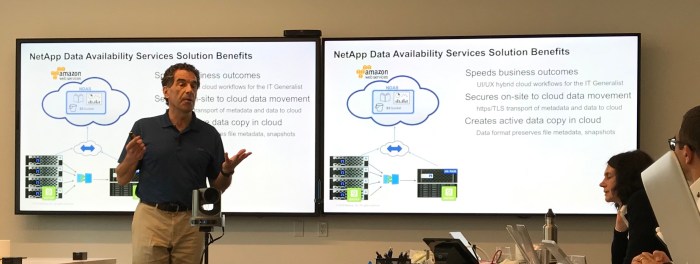
NetApp co-founder, Dave Hitz announced he was becoming a NetApp Founder Emeritus at the Storage Field Day (SFD18) show. He gave a great session about what he and his Hitz foundation’s been doing (for one example see our Archeology meets big data, post). He also discussed at length where he felt the storage world (and NetApp) must do to address the opportunities of the new cloud world. But this post isn’t about Dave, it’s about NetApp Data Availability Service, NDAS.
NetApp NDAS, currently in Beta but GAing (hopefully) later this year, is an AWS marketplace data orchestration solution that manages primary to secondary to S3 movement for ONTAP data. Essentially, NetApp Data Availability Services extends ONTAP data lifecycle management to AWS cloud. But it’s more than just a way to archive ONTAP data.
NDAS orchestrates Snapmirror services across ONTAP systems and AWS. But once your ONTAP data is in S3 it supplies access to that data for authorized AWS applications and services. That way one can use their ONTAP data to provide data analytics, train AI models, and do just about anything you can do with AWS applications today. By using NDAS, customers can extract more value from their ONTAP data.
NDAS is not just copying data to S3 but is also copying ONTAP metadata, catalogues and other information that provides context for that data. By copying ONTAP catalog information, customers and authorized end users can have file level access to ONTAP data residing in S3 objects.
NDAS today, only supports copying data from secondary ONTAP systems to S3. But a future enhancement will expand this to copy primary ONTAP data to S3.
How does NDAS work
NDAS provisions (your) EC2 instances, and middleware to read the data from the secondary systems and copy it to S3 buckets which you provide. NDAS after initial configuration to point to your ONTAP secondary storage systems, will autodiscover all the data available that can be copied to the cloud.
NDAS will start cataloguing your ONTAP data. NDAS EC2 instances support the NDAS copy, view and a Google-like search processes.
NDAS search presents a simplified file system view into your ONTAP data copied to S3. That way customers can identify data that could be used for AI training or data analytics that run in the cloud to access the data.
There’s extensive security to insure that NDAS is properly authorized to access your ONTAP data. Normal S3 security options also apply such as to have the data be encrypted on S3. NDAS data is automatically encrypted in flight.
Moreover, NDAS S3 bucket data can be replicated across AWS regions . Also serverless/lambda funationality are fully supported from or NDAS S3 buckets. .
What can it do with the data
AWS applications can access the data directly through NDAS APIs. Or customers can manually extract data they want to further process using the NDAS GUI to identify and copy data of interests. NDAS essentially creates a small app layer that allows users to view and access the ONTAP data in S3 as a file system.
One can have different NDAS AMIs operating in different regions for faster access or to support GDPR compliance requirements. Alternatively, a customer could have one NDAS AMI accessing all their secondary ONTAP instances.
NDAS is intended to provide a data analyst or IT generalist access to ONTAP data. This way AI training and big data analytics applications which run easily in the cloud, can have access to ONTAP data. In this way, customers can more effectively utilize data that IT has been storing and maintaining, since time began.
One NDAS beta customer is a MLB team. They have over time instrumented their stadiums to generate lot’s of data about pitch speed, rotation, ball location as it crosses the plate, etc. The problem with all this data is siloed in onprem or IOT systems that generated it. But the customer wants to use the data to improve players, coaches and the viewer experience. And all that needs tools, applications and software that’s just not available to run in the data center. But with NDAS all this data is now available to cloud applications.
NDAS is supported by any ONTAP 9.5 or later (FAS, AFF, Cloud ONTAP, ONTAPselect) secondary storage system. ONTAP 9.5 software contains all the services required to support NDAS. This includes the copy-to-cloud APIs, as well as the NDAS proxy, which supplies the secure interface to NDAS operating in the cloud.
NetApp’s NDAS sessions are pretty informative. Anyone interested in finding out more should checkout the videos available on TechFieldDay website and Dave’s session is also worth a view.
For more information on Dave’s session and NDAS check out:
One startup that caught my eye was SpaceBelt from Cloud Constellation Corporation, that’s planning to put PB (4X library of congress) of data storage in a constellation of LEO satellites.
The LEO storage pool will be populated by multiple nodes (satellites) with a set of geo-synchronous access points to the LEO storage pool. Customers use ground based secure terminals to talk with geosynchronous access satellites which communicate to the LEO storage nodes to access data.
Their main selling points appear to be data security and availability. The only way to access the data is through secured satellite downlinks/uplinks and then you only get to the geo-synchronous satellites. From there, those satellites access the LEO storage cloud directly. Customers can’t access the storage cloud without going through the geo-synchronous layer first and the secured terminals.
The problem with terrestrial data is that it is prone to security threats as well as natural disasters which take out a data center or a region. But with all your data residing in a space cloud, such concerns shouldn’t be a problem. (However, gaining access to your ground stations is a whole different story.
AWS and Lockheed-Martin supply new ground station service
The other company of interest is not a startup but a link up between Amazon and Lockheed Martin (see: Amazon-Lockheed Martin …) that supplies a new cloud based, satellite ground station as a service offering. The new service will use Lockheed Martin ground stations.
Currently, the service is limited to S-Band and attennas located in Denver, but plans are to expand to X-Band and locations throughout the world. The plan is to have ground stations located close to AWS data centers, so data center customers can have high speed, access to satellite data.
There are other startups in the ground station as a service space, but none with the resources of Amazon-Lockheed. All of this competition is just getting off the ground, but a few have been leasing idle ground station resources to customers. The AWS service already has a few big customers, like DigitalGlobe.
One thing we have learned, is that the appeal of cloud services is as much about the ecosystem that surrounds it, as the service offering itself. So having satellite ground stations as a service is good, but having these services, tied directly into other public cloud computing infrastructure, is much much better. Google, Microsoft, IBM are you listening?
Data centers in space
Why stop at storage? Wouldn’t it be better to support both storage and computation in space. That way access latencies wouldn’t be a concern. When terrestrial disasters occur, it’s not just data at risk. Ditto, for security threats.
Having whole data centers, would represent a whole new stratum of cloud computing. Also, now IT could implement space native applications.
If Microsoft can run a data center under the oceans, I see no reason they couldn’t do so in orbit. Especially when human flight returns to NASA/SpaceX. Just imagine admins and service techs as astronauts.
And yet, security and availability aren’t the only threats one has to deal with. What happens to the space cloud when war breaks out and satellite killers are set loose.
Yes, space infrastructure is not subject to terrestrial disasters or internet based security risks, but there are other problems besides those and war that exist such as solar storms and space debris clouds. .
In the end, it’s important to have multiple, non-overlapping risk profiles for your IT infrastructure. That is each IT deployment, may be subject to one set of risks but those sets are disjoint with another IT deployment option. IT in space, that is subject to solar storms, space debris, and satellite killers is a nice complement to terrestrial cloud data centers, subject to natural disasters, internet security risks, and other earth-based, man made disasters.
On the other hand, a large, solar storm like the 1859 one, could knock every data system on the world or in orbit, out. As for under the sea, it probably depends on how deep it was submerged!!
I’ve written on Scratch before (see my 10 years of Scratch and still counting post). It’s essentially an object oriented, visual programming language for kids. Nontheless, it is pretty sophisticated. The team at MIT just released Scratch 3.0, with a number of new extensions and updates to make it easier to work with.
Google also has a visual object oriented programming tool, called Blockly. I’ve used a variant of Blockly to program an Android phone based robot controller. It’s ok, but Blocky lacks a good collaboration mode and editing large Blockly code modules is not as easy as it should be.
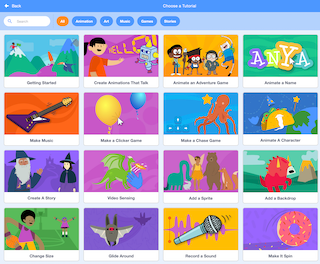
On the other hand Scratch is made for collaboration. They have a web page with 1000s of collaborations listed. Seems like there’s a bit for everyone on the collaboration list. And they have a a number of starter Scratch projects that anyone can tackle to earn coding cards that will gentling introduce you to scratch and coding.
Using Scratch
When I first ran across Scratch I used it to create sounds based on key combinations. Then I moved to animating sprites (drawn characters, which you can draw yourself or use one of many they have). Then I moved to animating planes, then groups of planes, then created a game where one plane would be followed by others. And then added a way where one plane could shoot another and so on.
It didn’t take me very long to get to a point where I had fleets of planes moving around the screen fighting each other. I haven’t done anything big with Scratch before but I’ve done a number of mini games/animations with my kids and it was fun to toy with.
Used to be you had to download and run Scratch locally on your PC/Mac. With later versions, they have Scratch Desktops that one can download for Windows and MacOS.
Alternatively, one could also use the web based version. In this way you can easily run it in any web browser.
The new desktop is more like a visual IDE than the old one I’m used to and looks exactly like the one on the web. The first Scratch I used presented itself in a table top screen with various Scratch tools surrounding this table top. I’m sure it makes things easier for beginning coders not to be presented with a Scratch world of tools right off the bat and just to have a sprite to play with. I suspect that all these tools are now buried in Scratch Tutorials
Scratch 3.0 comes with a number of extensions
One of the extensions allows you to program LEGO Robotics, another provides a way to interact with a blue tooth micro:bit controller, and another allows you to interact with your web cam to animate objects based on vision detection. There are plenty more and I’m sure this isn’t the end of them. (NB. Scratch team you need one for FIRST robotics) .
I just added a few for sounds and the text to speech extension. And it’s really easy to have Scratch 3.0 read out a text string for you. I suppose there would be a way for one to input a text file and have Scratch read it for you. But didn’t get that far with it.
~~~~
I am a strong supporter of everyone learning how to code and solutions like MIT’s Scratch (and Google’s Blockly) are a great way to understand coding without having to deal with the pain/semantics of compilers, APIs or function libraries etc.
Just start coding and having fun. it’s amazing what one can accomplish. That’s what Scratch was made to do, enjoy.
My money is on PyTorch and Tensorflow as being the two frameworks most likely to succeed. However all the above use many open source facilities and there seems to be a lot of cross breeding across them. Both AWS ML solutions and Microsoft CNTK offer PyTorch and TensorFlow frameworks/APIs as one option among many others.
AWS Machine Learning
I spent about an hour plus looking over the AWS SageMaker tutorial videos in the developer section of AWS machine learning curriculum. Signing up was fairly easy but I already had an AWS login. You also had to enroll/register for the course on your AWS login but once that was through, you could access courses.
In the comments on the AWS blog post there were a number of entries indicating broken links and other problems but I didn’t have any issues. Then again, I didn’t start at the beginning, only looked at over one series of courses, and was using the websites one week after they were announced at Re:Invent.
Amazon SageMaker is an overarching framework that can be used to perform machine learning on AWS, all the way from gathering, analyzing and modifying the dataset(s), to training the model, to creating a inference engine available as an endpoint that can be used to perform the inferencing.
Amazon also has special purpose API based tools that allow customers to embed intelligence (inferencing) directly into their application, without needing to perform the ML training. These include:
Amazon Recognitionwhich provides image (facial and other tagging) recognition services
Amazon Pollywhich provides text to speech services in multilple languages, and
Amazon Lexwhich provides speech recognition technology (used by Alexa) and together with Polly helps embed conversational interfaces into customer applications.
TensorFlow Machine Learning
In the past I looked over the TensorFlow tutorials and recently rechecked them out. I found them much easier to follow this time.
The Google IO 2018 video on TensorFlow, Getting Started With TensorFlow High Level APIs, takes you through a brief introduction to the Colab(oratory), a GCP solution that uses TensorFlow and how to use Tensorflow Keras, tf.data and TensorFlow Eager Execution to create machine learning models and perform machine learning.
Keras on TensorFlow seems to be the easiest approach to use machine learning technologies. The video spends most of the time discussing a Colab Keras code element, ~9 lines, that loads a image classification dataset, defines a 1 level (one standard layer and one output layer), trains it, validates it and uses it to perform inferencing.
The video also touches a bit on tf.data and TensorFlow Eager Executionbut the main portion discusses the 9 line TensorFlow Keras machine learning example.
Both Colab and AWS Sagemaker use and discuss Jupyter Notebooks. These appear to be an open source approach to documenting and creating a workflow and executing Python code automatically.
GCP Colab is essentially a GCP-Google Drive based Jupyter notebook execution engine. With Colab you create a Jupyter notebook on google drive and interactively execute it under Colab. You can download your Juyiter notebook files and essentially execute them anywhere else that supports TensorFlow (that supports TensorFlow v1.7 or above, with Keras API support).
In the video, the Google IO instructors (Josh Gordon and Lawrence Moroney) walk you through building a model to recognize handwritten digits and outputs a classification (0..9) of what the handwritten digit represents.
It uses a standard labeled handwriting to digits labeled data set, called the MNIST database of handwritten digits that’s already been broken up into a training set and a validation set. Josh calls this the “Hello World” of machine learning.
The instructor in the video walks you through the (Jupyter Notebook – Eager Execution-Keras) code that inputs the data set (line 2), builds a 1 level (really two layer, one neural net layer and one output layer) neural network model (lines 3-6), trains the model (line 7), tests/validates the model (line 8) and then uses it to perform an inference (line 9).
Josh spends a little time discussing neural networks and model optimizations and some of the other parameters used in the code above. He has a few visualizations of what this all means but for the most part, the code uses a simple way to build a neural net model and some standard optimization techniques for the network.
He then goes on to discuss tf.data which is an API that can be used to create machine learning datasets and provide this data to the neural net for training or inferencing. Apparently tf.data has a number of nifty features that allow you to take raw data and transform it into something that can be used to feed neural nets. For example, separating the data into batches, shuffling (randomizing) the batches of data, pre-fetching it so as to not starve the GPU matrix multipliers, etc.
Then it goes into how machine learning is different than regular coding. And show how TensorFlow Eager Execution is really just like Python execution. They go through another example (larger) of machine learning, this one distinguishes between cats and dogs. While they use an open source Python IDE , PyCharm, to test and walk through their TF Eager Execution code, setting breakpoints and examining data along the way.
Never got around to Microsoft’s Azure training other than previewing some websites but plan to look over that soon.
I would have to say that the Google IO session on using TensorFlow high level APIs was a lot more enjoyable (~40 minutes) than the AWS multiple tutorial videos (>>40 minutes) that I watched to learn about SageMaker.
Not a fair comparison as one was a Google IO intro session on TensorFlow high level APIs and the other was a series of actual training videos on Amazon SageMaker and the AWS services you can use to take advantage of it.
But the GCP session left me thinking I can handle learning more and using machine learning (via TensorFlow, Keras, Eager Execution, & tf.data) to actually do something while the SageMaker sessions left me thinking, how much AWS facilities and AWS infrastructure services, I would need to understand and use to ever get to actually developing a machine learning model.
I suppose one was more of an (AWS SageMaker) infrastructure tutorial and the other was more of an intro into machine learning using TensorFlow wherever you wanted to execute it.
I think I’m almost ready to start creating and feeding a TensorFlow model with my handwriting and seeing if it can properly interpret it into searchable text. If it can do that, I would be a happy camper
Comments…
Photo credits:
Screenshos from AWS Sagemaker series of tutorial video 1, 2, 3, 4 & 5, you may need a signin to view them