
NetApp co-founder, Dave Hitz announced he was becoming a NetApp Founder Emeritus at the Storage Field Day (SFD18) show. He gave a great session about what he and his Hitz foundation’s been doing (for one example see our Archeology meets big data, post). He also discussed at length where he felt the storage world (and NetApp) must do to address the opportunities of the new cloud world. But this post isn’t about Dave, it’s about NetApp Data Availability Service, NDAS.
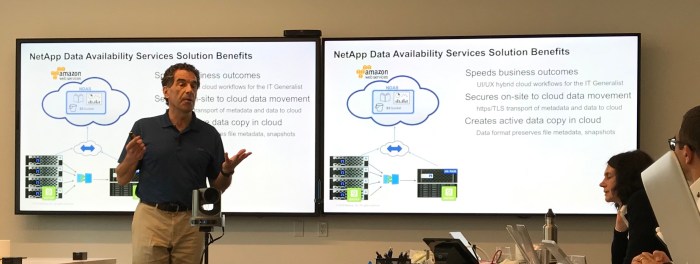
NetApp NDAS, currently in Beta but GAing (hopefully) later this year, is an AWS marketplace data orchestration solution that manages primary to secondary to S3 movement for ONTAP data. Essentially, NetApp Data Availability Services extends ONTAP data lifecycle management to AWS cloud. But it’s more than just a way to archive ONTAP data.
NDAS orchestrates Snapmirror services across ONTAP systems and AWS. But once your ONTAP data is in S3 it supplies access to that data for authorized AWS applications and services. That way one can use their ONTAP data to provide data analytics, train AI models, and do just about anything you can do with AWS applications today. By using NDAS, customers can extract more value from their ONTAP data.

NDAS is not just copying data to S3 but is also copying ONTAP metadata, catalogues and other information that provides context for that data. By copying ONTAP catalog information, customers and authorized end users can have file level access to ONTAP data residing in S3 objects.
NDAS today, only supports copying data from secondary ONTAP systems to S3. But a future enhancement will expand this to copy primary ONTAP data to S3.
How does NDAS work
NDAS provisions (your) EC2 instances, and middleware to read the data from the secondary systems and copy it to S3 buckets which you provide. NDAS after initial configuration to point to your ONTAP secondary storage systems, will autodiscover all the data available that can be copied to the cloud.
NDAS will start cataloguing your ONTAP data. NDAS EC2 instances support the NDAS copy, view and a Google-like search processes.
NDAS search presents a simplified file system view into your ONTAP data copied to S3. That way customers can identify data that could be used for AI training or data analytics that run in the cloud to access the data.
There’s extensive security to insure that NDAS is properly authorized to access your ONTAP data. Normal S3 security options also apply such as to have the data be encrypted on S3. NDAS data is automatically encrypted in flight.
Moreover, NDAS S3 bucket data can be replicated across AWS regions . Also serverless/lambda funationality are fully supported from or NDAS S3 buckets. .
What can it do with the data
AWS applications can access the data directly through NDAS APIs. Or customers can manually extract data they want to further process using the NDAS GUI to identify and copy data of interests. NDAS essentially creates a small app layer that allows users to view and access the ONTAP data in S3 as a file system.
One can have different NDAS AMIs operating in different regions for faster access or to support GDPR compliance requirements. Alternatively, a customer could have one NDAS AMI accessing all their secondary ONTAP instances.

NDAS is intended to provide a data analyst or IT generalist access to ONTAP data. This way AI training and big data analytics applications which run easily in the cloud, can have access to ONTAP data. In this way, customers can more effectively utilize data that IT has been storing and maintaining, since time began.
One NDAS beta customer is a MLB team. They have over time instrumented their stadiums to generate lot’s of data about pitch speed, rotation, ball location as it crosses the plate, etc. The problem with all this data is siloed in onprem or IOT systems that generated it. But the customer wants to use the data to improve players, coaches and the viewer experience. And all that needs tools, applications and software that’s just not available to run in the data center. But with NDAS all this data is now available to cloud applications.
NDAS is supported by any ONTAP 9.5 or later (FAS, AFF, Cloud ONTAP, ONTAPselect) secondary storage system. ONTAP 9.5 software contains all the services required to support NDAS. This includes the copy-to-cloud APIs, as well as the NDAS proxy, which supplies the secure interface to NDAS operating in the cloud.
NetApp’s NDAS sessions are pretty informative. Anyone interested in finding out more should checkout the videos available on TechFieldDay website and Dave’s session is also worth a view.
For more information on Dave’s session and NDAS check out:
NetApp, Cloudier than ever by Enrico Signoretti (@ESignoretti)
NetApp and the space in between by Dan Frith (@PenguinPunk)
~~~~
Comments?
 NetApp announced this week that their latest generation AFF (All Flash FAS) systems will support FC NVMeoF. We asked if this was just for NVMe SSDs or did it apply to all AFF media. The answer was it’s just another host interface which the customer can license for NVMe SSDs (available only on AFF F800) or SAS SSDs (A700S, A700, and A300). The only AFF not supporting the new host interface is their lowend AFF A220.
 They also christened their new Data Visualization Center (DVC) and we had a multi-course meal at the Bistro at the center. The DVC had a wrap around, 1.5 floor tall screen which showed some of NetApp customer success stories. Inside the screen was a more immersive setting and there was plenty of VR equipment in work spaces alongside customer conference rooms.
 It was the worst of times. The industry changes had been gathering for a decade almost and by this time were starting to hurt.
 The cloud was taking over all new business and some of the old. Flash’s performance was making high performance easy and reducing storage requirements commensurately. Software defined was displacing low and midrange storage, which was fine for margins but injurious to revenues.
 Hitachi Vantara is a brand new company that combines Hitachi Data Systems, Hitachi Insight Group and Pentaho (an analytics acquisition) into one organization to go after the IoT market. Pentaho will continue as a separate brand/subsidiary, but HDS and Insight Group cease to exist as separate companies/subsidiaries and are now inside Vantara.
 At their conference they announced a new Azure NFS service powered by NetApp. They already had Cloud ONTAP and NPS, both current cloud offerings, a software defined storage in the cloud and a co-lo hardware offering directly attached to public cloud (Azure & AWS), respectively.
 Attended VMworld2017 this past week in Vegas and aside from all the parties there was a lot of news, mostly for public cloud users.
 First up, VMware on the (AWS) cloud
 Where lies Photon and VIC (VMware Integrated Containers)


 I was at Dell EMC World2017 last week and although most of the news was on Dell’s new 14th generation server and Dell-EMC integration progress, Wednesday’s keynote was devoted to storage and non-server infrastructure news.
 Dell EMC Data Domain Cloud DR (DDCDR) is a new capability that enables DD to backup to AWS S3 object storage and when needed restart the virtual machines within AWS.
 Once the OVA is installed, it will read the changed data and will segment, encrypt, and compress the backup data and then send this and the backup metadata to AWS S3 objects. Avamar/DD policies can be established to control how many daily backup copies are to be saved to S3 object storage. There’s no need for Data Domain or Avamar to run in AWS.
 When there’s a problem at the primary data center, an admin can click on a Avamar GUI button and have the Cloud DR server, uncompress, decrypt, rehydrate and restore the backup data into EBS volumes, translate the VMware VM image to an AMI image and then restarts the AMI on an AWS virtual server (EC2) with its data on EBS volume storage. The Cloud DR server will use the backup metadata to select the AWS EC2 instance with the proper CPU and RAM needed to run the application. Once this completes, the VM is running standalone, in an AWS EC2 instance. Presumably, you have to have EC2 and EBS storage volumes resources available under your AWS domain to be able to install the application and restore its data.
 For simplicity purposes, the user can control almost all of the required functionality for DDCDR from the Avamar GUI alone. But in case of a site outage, the user can initiate the application DR from a portal supplied by the Cloud DR server utility.
 There was much more infrastructure news at Dell EMC World2017. I’ll discuss more details on their new storage offerings in my upcoming Storage Intelligence newsletter, due out the end of this month. If your interested in receiving your own copy of my newsletter, checkout the signup button in the upper right of this page.
 I have been reading
  Now the public cloud, although certainly a common pool of resources, is also most assuredly owned by corporations. So it’s not a true tragedy of the commons problem. Public cloud corporations have a real incentive to improve their services.

 Earlier this summer, Docker presented at Cloud Field Day 1 (CFD1) on some of their current technology and upcoming enhancements. (See the
  Containers are not VMs, they have a fundamentally different architecture. For instance,
 If you want to experiment with Docker, you can download
  Docker Swarms orchestrates the operation of multiple Docker Engines running Docker Services.