Hammerspace and the Open Flash Platform at #AIIFD3

Was at AI Infrastructure Field Day 3 (AIIFD3) last week in CA and Hammerspace presented. (videos here). Molly and Floyd talked about their solution and some of their recent MLCommon’s performance results but Kurt discussed the Open Flash Platform (OFP) Consortium, announced last July which they and partners have been working on..

OFP currently has 6 partners ranging from Hammerspace (storage software supplier), SK Hynix (NAND and SSDs) and Linux Foundation among others and includes end users (Las Alamos National Labs), computational storage (ScaleFlux) and AI solution providers (Xsight).

As I understand it, the OFP is pushing to become a standard adopted by the Open Compute Project (OCP).

OFP is an attempt to redefine NAS as we know it. Hammerspace has been on this journey for a long time with their software only solution but technology is now at a place where it’s time to tackle hardware changes to NAS that would enable even better performance and throughput for AI and other data intensive workloads.

Some of the technology changes driving the need for a different approach to NAS storage:

  • NAND capacities are going through the roof, accessing all that capacity in an effective and performant way, requires a re-architecturing of the storage stack
  • Compute is becoming more widespread and ubiquitous. Every thing seems to have more and more compute capability that it’s causing a rethink as to how to take advantage of all this ubiquitous compute to better address IT (and AI) performance needs
  • AI bandwidth and performance requirements are extreme and are only becoming more so. .
  • Power has become a limiting factor in many AI deployments.

Hammerspace has addressed much of this from a software perspective with their Linux standards efforts to implement Parallel File System and Flex Files in the Linux kernel and in NFS standards as NFSv4.2. PFS and FlexFiles allows Hammerspace to offer very high file bandwidth and data mobility that can’t be supplied any other way.

So it’s time to see what can be done in hardware to make this even better. Enter OFP.

OFP, NAS storage reborn

The idea is to come up with a new packaging of an NFS (v3) server that’s all storage with high amounts of networking and enough compute to serve the storage. Effectively they are putting a DPU (computational intensive networking card) with 1-800Gbps Ethernet connection in front of a train (or toboggan) of NVMe SSDs and calling this a sled.

Their first version using U.2 NVMe SSDs, offers 1PB of capacity with 800Gbps of networking in a 3.5″ X 1.75″ form factor. They would load a NFS v3 Linux based storage server in the DPU and have it run that along with the Networking stack (and more) on the DPU and have access to all this storage capacity in what essentially is a NFSv3 (relatively dumb storage) storage sled.

Package 6 of these together with a couple of power supplies and now you have 6PB raw capacity in 1RU, with 4.8Tbps of bandwidth, consuming .6 kW of power (presumably this is power consumption at idle).

You will no doubt note that the sled, as configured above, does not allow for hot (or even cold) drive replacement. So when drives fail, the NFSv3 code would need to recover from them and take them out of service. So that over time the sled could still be used even though some SSDs have failed.

In the future, moving from U.2 SSDs to E2(E) NVMe SSDs in the storage sled quadruples the capacity while staying in the same power envelope and supplying the same bandwidth. Again the SSDs are not intended to be (hot or cold) swappable, so drive failure would need to be handled by software. With E2(E) SSDs in a sled and 6 of these in a 1RU, one would have 24PB of storage capacity.

Presumably, OFP Sleds could be hot swappable when enough SSDs in a sled fails.

And of course QLC capacities are not standing still so another doubling of these capacities could easily be possible within the next couple of years (imagine 48PB in a single RU, boggles the mind).

The NAS software one runs in the OFP SLED could be any NFSv3 server software but Hammerspace has their own, called DSX. And when you combine DSX servers with lots of capacity and lots of networking bandwidth, Hammerspace’s NFSv4.2 PFS and FlexFiles can really fly.

And with the power and space efficiency as well as extreme bandwidth available, it could be a winning formula for the AI environments, in contrast to scale-out NAS which is the current alternative.

~~~~

But it seems to me any organization (hypervisors are you listening) with intense storage capacity and storage bandwidth needs would be very interested in the OFP for their own environment.

Comments?

SOENs can reach AGI scale – AGI Part 11, ASI Part 2, Neuromorphic Part 7

At OCP summit researchers from NIST presented the winning paper and poster session, Supercomuters for AI based on Superconducting Optoelectronic Networks (SOENs) which discussed how one could use optical networking (waveguide, free space, optical fibre) with superconducting electronics (Single Photon Detectors, SPDs and Josephson Junctions, JJs) to construct an Neuromorphic simulation of biological neurons.

The cited paper is not available but the poster was (copied below) and it referred to an earlier paper, Optoelectronic Intelligence, which is available online if you want to learn more on the technology.

Some preliminaries before we hit the meat of the solution. Biological neurons are known to operate as spiking devices that only fire when sufficient input (ions, electronic charge) or a threshold of charge is present and once fired (or depleted), it takes another round of input ions of sufficient threshold of charge to make them fire again.

Biological neurons are connected to one another via dendrites which are long input connections and axons or output clusters via a synapse (air-liquid gap). Neurons are interconnected within micro-columns, columns, clusters and complexes which form the functional unit of the brain. Furtional units inter-connect (via axons – synapses – dendrite) to form brain subsystems such as the visual system, memory system, auditory system, etc..

DNNs vs the Human Brain

Current deep neural networks, DNNs, the underlying technology for all AI today is a digital approach to emulating brain electronic processing. DNNs uses layers of nodes, with each node connected to all the nodes in a layer above and all the nodes in layers below. For a specific DNN node to fire depends on its inputs multiplied by its weight and and added by its bias.

DNNs use a feed forward approach where inputs are fed into nodes at the bottom layer and proceed upward based on the weights and biases for each node in each layer resulting in an output at the top most layer (or bottom most layer depending on your preferred orientation). 

Today’s DNN foundation models are built using trillions (10**12) of nodes (parameters) and consume city levels of power to train. 

In comparison the human brain has approximately 10B (10**10) neurons and maybe 1000X that in connections between neurons. N.B. Neurons don’t connect to every neuron in a micro column.  

So what’s apparent in the above is that the human brain requires significantly less neurons as compared to DNN nodes. And even with that significantly fewer neurons is capable of much more complex thought and reasoning. And the power consumption of the human brain is on the order of a few W, whereas foundation models which consume GW of power to train and KW to inference.

SOENs, a better solution

SOENs, superconducting optoelectronic networks, are a much closer approximation to human neurons and can be connected in such a fashion that within the scale of a couple of 2M**3 could support (with todays 45nm chip technology) 10B SOENs with 1000s of connections between them.

SOENs are a composite circuits representing single photon detectors (SPDs), Josephon Junctions (JJs) and light generating transistor circuits. Both the SPDs and JJs require cryogenic cooling to operate properly. 

“(a) Optoelectronic neuron. Electrical connections are shown as straight, black arrows, and photons are shown as wavy, [blue] arrows… Part (a) adapted from J. M. Shainline, IEEE J. Sel. Top. Quantum Electron. 26, 1 (2020). Copyright 2020 Author(s), licensed under a Creative Commons Attribution (CC BY) license.43”
Circuit diagrams. (a) Superconducting optoelectronic synapse combining a single-photon detector (SPD) with a Josephson junction and a flux-storage loop, referred to as the synaptic integration (SI) loop. The synaptic bias current (Isy) can dynamically adapt the synaptic weight. (b) Neuron cell body performing summation of the signals from many synapses as well as thresholding. Here the neuronal receiving (NR) loop is shown collecting inputs from two SI loops, but scaling to thousands of input connections appears possible. Upon reaching threshold, the transmitter circuit produce a pulse of light that communicates photons to downstream synapses. The neuronal threshold current (Ith) can dynamically adapt the neuronal threshold.

SOENs have biases and thresholds similar to both biological neurons and DNN nodes which are used to boost signals and as gates to limit firings.

g) Schematic of multi-planar integrated waveguides for dense routing. Adapted from Chiles et al., APL Photonics 2, 116101 (2017). Copyright 2017 Author(s), licensed under a Creative Commons Attribution (CC BY) license.

When an SOEN fires it transmits a single photon of light to the reciever (SPD) of another SOEN. That photon travels within wafers in waveguides that are created in planes of the wafer. That photon could travel across to another wafer using optical connections. And that wafer could travel up or down using free space optics to wafers located above or below it. 

There are other nueromorphic architectures out there but none that have the potential to scale to the human brain level of complexity with today’s technology.

And of course because SOENs are optoelectronics devices something on the scale of human brain (10B SOENs) would operate 1000s of times faster. 

At the show the presenter mentioned that it would only take about $100M to fabricate the SOENs needed to simulate the equivalent of a human brain

I think they should start a go-fund me project and get cracking… AGI is on the way.

And the real question is why stop there…

Picture Credits:

Enfabrica MegaNIC, a solution to GPU backend networking #AIFD5

I attended AI FieldDay 5 (AIFD5) last week and there were networking vendors there discussing how their systems dealt with backeng GPU network congestion issues. Most of these were traditional vendor congestion solutions.

However, one vendor, Enfabrica, (videos of their session will be available here) seemed to be going down a different path, which involved a new ASIC design destined to resolve all the congestion, power, and performance problems inherent in current backend GPU Ethernet networks.

In essence, Enfabrica’s Super or MegaNIC (they used both terms during their session) combines PCIe lanes switching, Ethernet networking, and ToR routing with SDN (software defined networking) programability to connect GPUs directly to a gang of Ethernet links. This allows it to replace multiple (standard/RDMA/RoCEv2) NIC cards with one MegaNIC using their ACF-S (Advanced Compute Fabric SuperNic) ASIC.

Their first chip, codenamed “Millennium” supports 8Tbps bandwidth.

Their ACF-S chip provides all the bandwidth needed to connect up to 4 GPUs to 32/16/8/4-100/200/400/800Gbps links. And because their ACF-S chip controls and drives all these network connections, it can better understand and deal with congestion issues backend GPU networks. And it is PCIe 5/6 compliant, supporting 128-160 lanes.

Further, it has onboard ARM processing to handle its SDN operations, onboard hardware engines to accelerate networking protocol activity and network and PCIe switching hardware to support directly connecting GPUs to Ethernet links.

With its SDN, it supports current RoCE, RDMA over TCP, UEC direct, etc. network protocols.

It took me (longer than it should) to get my head around what they were doing but essentially they are supporting all the NIC-TOR functionality as well as PCIe functionality needed to connect up to 4 GPUs to a backend Ethernet GPU network.

On the slide above I was extremely skeptical of the Every 10^52 Years “job failures due to NIC RAIL failures”. But Rochan said that these errors are predominantly optics failures and as both the NIC functionality and ToR switch functionality is embedded in the ACF-S silicon, those faults should not exist.

Still 10^52 years is a long MTBF rate (BTW, the universe is only 10^10 years old). And there’s still software controlling “some” of this activity. It may not show up as a “NIC RAIL” failure, but there will still be “networking” failures in any system using ACF-S devices.

Back to their solution. What this all means is you can have one less hop in your backend GPU networks leading to wider/flatter backend networks and a lot less congestion on this network. This should help improve (GPU) job performance, networking performance and reduce networking power requirements to support your 100K GPU supercluster.

At another session during the show, Arista (videos will be available here) said that just the DSP/LPO optics alone for a 100K GPU backend network will take a 96/32 MW of power. Unclear whether this took into consideration within rack copper connections. But anyway you cut it, it’s a lot of power. Of course the 100K GPUs would take 400MW alone (at 4KW per GPU).

Their ACF-S driver has been upstreamed into standard CCL and Linux distributions, so once installed (or if you are at the proper versions of CCL & Linux software), it should support complete NCCL (NVIDIA Collective Communications Library) stack compliance.

And because, with its driver installed and active, it talks standard Ethernet and standard PCIe protocols on both ends, it is should fully support any other hardware that comes along attaching to these networks or busses (CXL perhaps)

The fact that this may or may not work with other (GPU) accelerators seems moot at this point as NVIDIA owns the GPU for AI acceleration market. But the flexibility inherent in their own driver AND on chip SDN, indicates for the right price, just about any communications link software stack could be supported.

After spending most of the rest of AIFD5 discussing how various vendors deal with congestion for backend GPU networks, having startup on the stage with a different approach was refreshing.

Whether it reaches adoption and startup success is hard to say at this point. But if it delivers on what it seems capable of doing for power, performance and network flexibility, anybody deploying new greenfield GPU superclusters ought to take a look at Enfabricas solution. .

MegaNIC/ACF-S pilot boxes are available for order now. No indication as to what these would cost but if you can afford 100K GPUs it’s probably in the noise…

~~~~

Comments?

AI benchmark for Storage, MLpERF Storage

MLperf released their first round of storage benchmark submissions early this month. There’s plenty of interest how much storage is required to keep GPUs busy for AI work. As a result, MLperf has been busy at work with storage vendors to create a benchmark suitable to compare storage systems under a “simulated” AI workload.

For the v0.5 version ,they have released two simulated DNN training workloads one for image segmentation (3D-Unet [146 MB/sample]) and the other for BERT NLP (2.5 KB/sample).

The GPU being simulated is a NVIDIA V100. What they showing with their benchmark is a compute system (with GPUs) reading data directly from a storage system.

By using simulated (GPU) compute, the benchmark doesn’t need physical GPU hardware to run. However, the veracity of the benchmark is somewhat harder to depend on.

But, if one considers, the reported benchmark metric, # supported V100s, as a relative number across the storage submissions, one is on more solid footing. Using it as a real number of V100s that could be physically supported is perhaps invalid.

The other constraint from the benchmark was keeping the simulated (V100) GPUs at 90% busy. MLperf storage benchmark reports, number of samples/second,MBPS metrics as well as # simulated (V100) GPUs supported (@90% utilization).

In the bar chart we show the top 10 # of simulated V100 GPUs for image segmentation storage submissions, DDN AI400X2 had 5 submissions in this category.

The interesting comparison is probably between DDN’s #1 and #3 submission.

  • The #1 submission had smaller amount of data (24X3.5TB = 64TB of flash), used 200Gbps InfiniBand, with 16 compute nodes and supported 160 simulated V100s.
  • The #3 submission had more data (24X13.9TB=259TB of flash),used 400Gbps InfiniBand with 1 compute node and supports only 40 simulated V100s

It’s not clear why the same storage, with less flash storage, and slower interfaces would support 4X the simulated GPUs than the same storage, with more flash storage and faster interfaces.

I can only conclude that the number of compute nodes makes a significant difference in simulated GPUs supported.

One can see a similar example of this phenomenon with Nutanix #2 and #6 submissions above. Here the exact same storage was used for two submissions, one with 5 compute nodes and the other with just 1 but the one with more compute nodes supported 5X the # of simulated V100 GPUs.

Lucky for us, the #3-#10 submissions in the above chart, all used one compute node and as such are more directly comparable.

So, if we take #3-#5 in the chart above, as the top 3 submissions (using 1 compute node), we can see that the #3 DDN AI400X2 could support 40 simulated V100s, the #4 Weka IO storage cluster could support 20 simulated V100s and the #5 Micron NVMe SSD could support 17 simulated V100s.

The Micron SSD used an NVMe (PCIe Gen4) interface while the other two storage systems used 400Gbps InfiniBand and 100Gbps Ethernet, respectively. This tells us that interface speed, while it may matter at some point, doesn’t play a significant role in determining the # simulated V100s.

Both the DDN AI4000X2 and Weka IO storage systems are sophisticated storage systems that support many protocols for file access. Presumably the Micron SSD local storage was directly mapped to a Linux file system.

The only other MLperf storage benchmark that had submissions was for BERT, a natural language model.

In the chart, we show the # of simulated V100 GPUs on the vertical axis. We see the same impact here of having multiple compute nodes in the #1 DDN solution supporting 160 simulated V100s. But in this case, all the remaining systems, used 1 compute node.

Comparing the #2-4 BERT submissions, both the #2 and #4 are DDN AI400X2 storage systems. The #2 system had faster interfaces and more data storage than the #4 system and supported 40 simulated GPUs vs the other only supporting 10 simulated V100s.

Once again, Weka IO storage system came in at #3 (2nd place in the 1 compute node systems) and supported 24 simulated V100s.

A couple of suggestions for MLperf:

  • There should be different classes of submissions one class for only 1 compute node and the other for any number of compute nodes.
  • I would up level the simulated GPU configurations to A100 rather than V100s, which would only be one generation behind best in class GPUs.
  • I would include a standard definition for a compute node. I believe these were all the same, but if the number of compute nodes can have a bearing on the number of V100s supported, the compute node hardware/software should be locked down across submissions.
  • We assume that the protocol used to access the storage oven InfiniBand or Ethernet was standard NFS protocols and not something like GPUDirect storage or other RDMA variants. As the GPUs were simulated this is probably correct but if not, it should be specfied
  • I would describe the storage configurations with more detail, especially for software defined storage systems. Storage nodes for these systems can vary significantly in storage as well as compute cores/memory sizes which can have a significant bearing on storage throughput.

To their credit this is MLperfs first report on their new Storage benchmark and I like what I see here. With the information provided, one can at least start to see some true comparisons of storage systems under AI workloads.

In addition to the new MLperf storage benchmark, MLperf released new inferencing benchmarks which included updates to older benchmark NN models as well as a brand new GPT-J inferencing benchmark. I’ll report on these next time.

~~~~

Comments?

New era of graphical AI is near #AIFD2 @Intel

I attended AIFD2 ( videos of their sessions available here) a couple of weeks back and for the last session, Intel presented information on what they had been working on for new graphical optimized cores and a partner they have, called Katana Graph, which supports a highly optimized graphical analytics processing tool set using latest generation Xeon compute and Optane PMEM.

What’s so special about graphs

The challenges with graphical processing is that it’s nothing like standard 2D tables/images or 3D oriented data sets. It’s essentially a non-Euclidean data space that has nodes with edges that connect them.

But graphs are everywhere we look today, for instance, “friend” connection graphs, “terrorist” networks, page rank algorithms, drug impacts on biochemical pathways, cut points (single points of failure in networks or electrical grids), and of course optimized routing.

The challenge is that large graphs aren’t easily processed with standard scale up or scale out architectures. Part of this is that graphs are very sparse, one node could point to one other node or to millions. Due to this sparsity, standard data caching fetch logic (such as fetching everything adjacent to a memory request) and standardized vector processing (same instructions applied to data in sequence) don’t work very well at all. Also standard compute branch prediction logic doesn’t work. (Not sure why but apparently branching for graph processing depends more on data at the node or in the edge connecting nodes).

Intel talked about a new compute core they’ve been working on, which was was in response to a DARPA funded activity to speed up graphical processing and activities 1000X over current CPU/GPU hardware capabilities.

Intel presented on their PIUMA core technology was also described in a 2020 research paper (Programmable Integrated and Unified Memory Architecture) and YouTube video (Programmable Unified Memory Architecture).

Intel’s PIUMA Technology

DARPA’s goals became public in 2017 and described their Hierarchical Identity Verify Exploit (HIVE) architecture. HIVE is DOD’s description of a graphical analytics processor and is a multi-institutional initiative to speed up graphical processing. .

Intel PIUMA cores come with a multitude of 64-bit RISC processor pipelines with a global (shared) address space, memory and network interfaces that are optimized for 8 byte data transfers, a (globally addressed) scratchpad memory and an offload engine for common operations like scatter/gather memory access.

Each multi-thread PIUMA core has a set of instruction caches, small data caches and register files to support each thread (pipeline) in execution. And a PIUMA core has a number of multi-thread cores that are connected together.

PIUMA cores are optimized for TTEPS (Tera-Traversed Edges Per Second) and attempt to balance IO, memory and compute for graphical activities. PIUMA multi-thread cores are tied together into (completely connected) clique into a tile, multiple tiles are connected within a single node and multiple nodes are tied together with a 8 byte transfer optimized network into a PIUMA system.

P[I]UMA (labeled PUMA in the video) multi-thread cores apparently eschew extensive data and instruction caching to focus on creating a large number of relatively simple cores, that can process a multitude of threads at the same time. Most of these threads will be waiting on memory, so the more threads executing, the less likely that whole pipeline will need to be idle, and hopefully the more processing speedup can result.

Performance of P[I]UMA architecture vs. a standard Xeon compute architecture on graphical analytics and other graph oriented tasks were simulated with some results presented below.

Simulated speedup for a single node with P[I]UMAtechnology vs. Xeon range anywhere from 3.1x to 279x and depends on the amount of computation required at each node (or edge). (Intel saw no speedups between a single Xeon node and multiple Xeon Nodes, so the speedup results for 16 P[I]UMA nodes was 16X a single P[I]UMA node).

Having a global address space across all PIUMA nodes in a system is pretty impressive. We guess this is intrinsic to their (large) graph processing performance and is dependent on their use of photonics HyperX networking between nodes for low latency, small (8 byte) data access.

Katana Graph software

Another part of Intel’s session at AIFD2 was on their partnership with Katana Graph, a scale out graph analytics software provider. Katana Graph can take advantage of ubiquitous Xeon compute and Optane PMEM to speed up and scale-out graph processing. Katana Graph uses Intel’s oneAPI.

Katana graph is architected to support some of the largest graphs around. They tested it with the WDC12 web data commons 2012 page crawl with 3.5B nodes (pages) and 128B connections (links) between nodes.

Katana runs on AWS, Azure, GCP hyperscaler environment as well as on prem and can scale up to 256 systems.

Katana Graph performance results for Graph Neural Networks (GNNs) is shown below. GNNs are similar to AI/ML/DL CNNs but use graphical data rather than images. One can take a graph and reduce (convolute) and summarize segments to classify them. Moreover, GNNs can be used to understand whether two nodes are connected and whether two (sub)graphs are equivalent/similar.

In addition to GNNs, Katana Graph supports Graph Transformer Networks (GTNs) which can analyze meta paths within a larger, heterogeneous graph. The challenge with large graphs (say friend/terrorist networks) is that there are a large number of distinct sub-graphs within the graph. GTNs can break heterogenous graphs into sub- or meta-graphs, which can then be used to understand these relationships at smaller scales.

At AIFD2, Intel also presented an update on their Analytics Zoo, which is Intel’s MLops framework. But that will need to wait for another time.

~~~~

It was sort of a revelation to me that graphical data was not amenable to normal compute core processing using today’s GPUs or CPUs. DARPA (and Intel) saw this defect as a need for a completely different, brand new compute architecture.

Even so, Intel’s partnership with Katana Graph says that even today compute environment could provide higher performance on graphical data with suitable optimizations.

It would be interesting to see what Katana Graph could do using PIUMA technology and appropriate optimizations.

In any case, we shouldn’t need to wait long, Intel indicated in the video that P[I]UMA Technology chips could be here within the next year or so.

Comments?

Photo Credit(s):

  • From Intel’s AIFD2 presentations
  • From Intel’s PUMA you tube video

Is hardware innovation accelerating – hardware vs. software innovation (round 6)

There’s something happening to the IT industry, that maybe has not happened in a couple of decades or so but hardware innovation is back. We’ve been covering bits and pieces of it in our hardware vs software innovation series (see Open source ASiCs – HW vs. SW innovation [round 5] post).

But first please take our new poll:

Hardware innovation never really went away, Intel, AMD, Apple and others had always worked on new compute chips. DRAM and NAND also have taken giant leaps over the last two decades. These were all major hardware suppliers. But special purpose chips, non CPU compute engines, and hardware accelerators had been relegated to the dustbins of history as the CPU giants kept assimilating their functionality into the next round of CPU chips.

And then something happened. It kind of made sense for GPUs to be their own electronics as these were SIMD architectures intrinsically different than SISD, standard von Neumann X86 and ARM CPUs architectures

But for some reason it didn’t stop there. We first started seeing some inklings of new hardware innovation in the AI space with a number of special purpose DL NN accelerators coming online over the last 5 years or so (see Google TPU, SC20-Cerebras, GraphCore GC2 IPU chip, AI at the Edge Mythic and Syntiants IPU chips, and neuromorphic chips from BrainChip, Intel, IBM , others). Again, one could look at these as taking the SIMD model of GPUs into a slightly different direction. It’s probably one reason that GPUs were so useful for AI-ML-DL but further accelerations were now possible.

But it hasn’t stopped there either. In the last year or so we have seen SPUs (Nebulon Storage), DPUs (Fungible, NVIDIA Networking, others), and computational storage (NGD Systems, ScaleFlux Storage, others) all come online and become available to the enterprise. And most of these are for more normal workload environments, i.e., not AI-ML-DL workloads,

I thought at first these were just FPGAs implementing different logic but now I understand that many of these include ASICs as well. Most of these incorporate a standard von Neumann CPU (mostly ARM) along with special purpose hardware to speed up certain types of processing (such as low latency data transfer, encryption, compression, etc.).

What happened?

It’s pretty easy to understand why non-von Neumann computing architectures should come about. Witness all those new AI-ML-DL chips that have become available. And why these would be implemented outside the normal X86-ARM CPU environment.

But SPU, DPUs and computational storage, all have typical von Neumann CPUs (mostly ARM) as well as other special purpose logic on them.

Why?

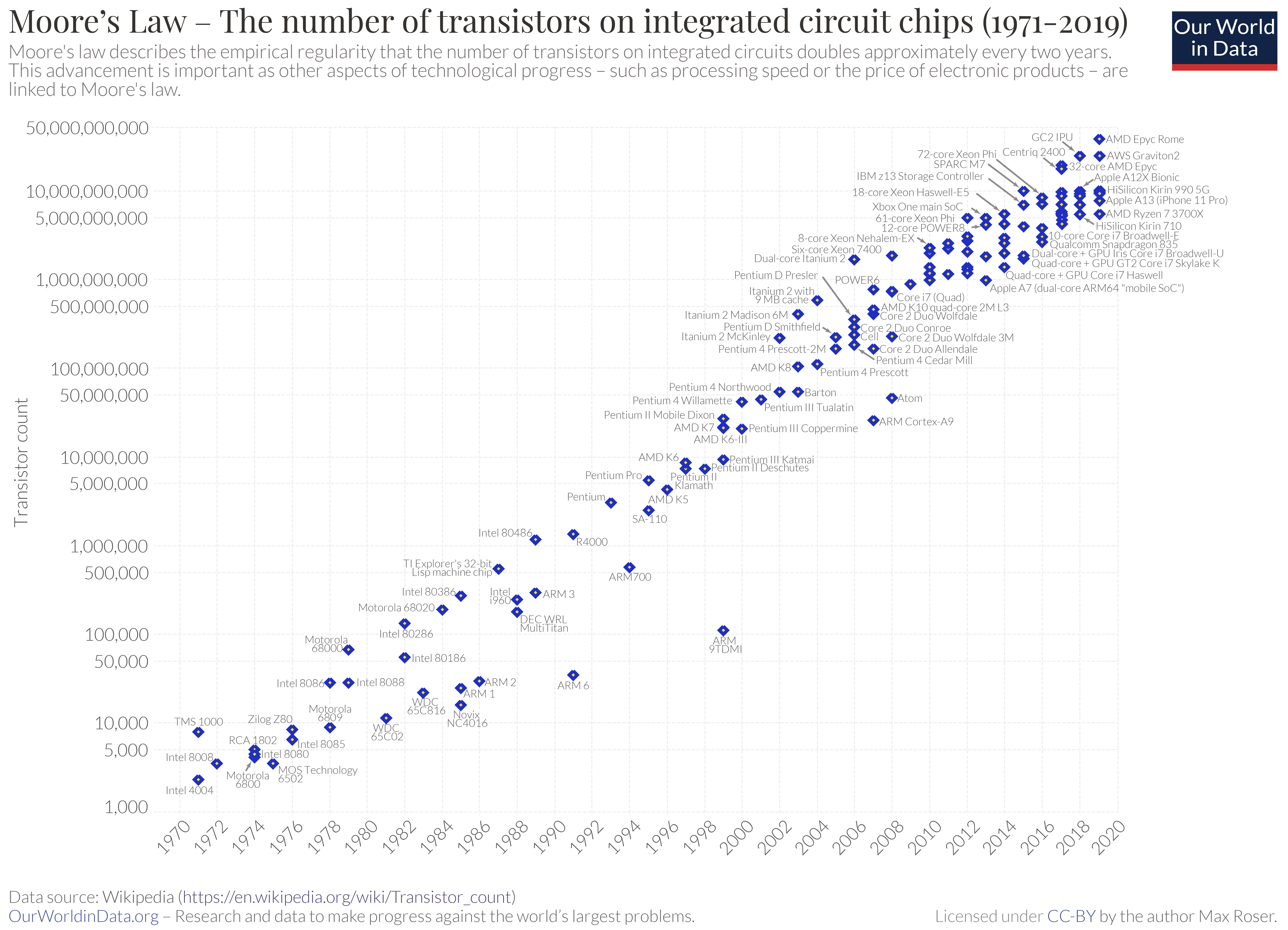
I believe there are a few reasons, but the main two are that Moore’s law (every 2 years halving the size of transistors, effectively doubling transistor counts in same area) is slowing down and Dennard scaling (as you reduce the size of transistors their power consumption goes down and speed goes up) has stopped almost. Both of these have caused major CPU chip manufacturers to focus on adding cores to boost performance rather than just adding more transistors to the same core to increase functionality.

This hasn’t stopped adding instruction functionality to each CPU, but it has slowed considerably. And single (core) processor speeds (GHz) have reached a plateau.

But what it has stopped is having the real estate available on a CPU chip to absorb lots of additional hardware functionality. Which had been the case since the 1980’s.

I was talking with a friend who used to work on math co-processors, like the 8087, 80287, & 80387 that performed floating point arithmetic. But after the 486, floating point logic was completely integrated into the CPU chip itself, killing off the co-processors business.

Hardware design is getting easier & chip fabrication is becoming a commodity

We wrote a post a couple of weeks back talking about an open foundry (see HW vs. SW innovation round 5 noted above)that would take a hardware design and manufacture the ASICs for you for free (or at little cost). This says that the tool chain to perform chip design is becoming more standardized and much less complex. Does this mean that it takes less than 18 months to create an ASIC. I don’t know but it seems so.

But the real interesting aspect of this is that world class foundries are now available outside the major CPU developers. And these foundries, for a fair but high price, would be glad to fabricate a 1000 or million chips for you.

Yes your basic state of the art fab probably costs $12B plus these days. But all that has meant is that A) they will take any chip design and manufacture it, B) they need to keep the factory volume up by manufacturing chips in order to amortize the FAB’s high price and C) they have to keep their technology competitive or chip manufacturing will go elsewhere.

So chip fabrication is not quite a commodity. But there’s enough state of the art FABs in existence to make it seem so.

But it’s also physics

The extremely low latencies that are available with NVMe storage and, higher speed networking (100GbE & above) are demanding a lot more processing power to keep up with. And just the physics of how long it takes to transfer data across a distance (aka racks) is starting to consume too much overhead and impacting other work that could be done.

When we start measuring IO latencies in under 50 microseconds, there’s just not a lot of CPU instructions and task switching that can go on anymore. Yes, you could devote a whole core or two to this process and keep up with it. But wouldn’t the data center be better served keeping that core busy with normal work and offloading that low-latency, realtime (like) work to a hardware accelerator that could be executing on the network rather than behind a NIC.

So real time processing has become faster, or rather the amount of time to execute CPU instructions to switch tasks and to process data that needs to be done in realtime to keep up with faster line speed is becoming shorter.

So that explains DPUs, smart NICS, DPUs, & SPUs. What about the other hardware accelerator cards.

  • AI-ML-DL is becoming such an important and data AND compute intensive workload that just like GPUs before them, TPUs & IPUs are becoming a necessary evil if we want to service those workloads effectively and expeditiously.
  • Computational storage is becoming more wide spread because although data compression can be easily done at the CPU, it can be done faster (less data needs to be transferred back and forth) at the smart Drive.

My guess we haven’t seen the end of this at all. When you open up the possibility of having a long term business model, focused on hardware accelerators there would seem to be a lot of stuff that needs to be done and could be done faster and more effectively outside the core CPU.

There was a point over the last decade where software was destined to “eat the world”. I get a lot of flack for saying that was BS and that hardware innovation is really eating the world. Now that hardtware innovation’s back, it seems to be a little of both.

Comments?

Photo Credits:

Where should IoT data be processed – part 2

I wrote a post a while back on Where IOT data should be processed – part 1. We will get back to that post in a moment, but recently I read an article (How big data forced the hunt for ET intelligence to evolve) that mentioned after 20 years, they were shutting down SETI@home.

SETI@home was a crowdsourced computational network that took snippets of radio spectrum, sent them to 1000s of home computers to be analyzed during idle computer time, once processed the analysis was sent back to SETI@home. It was one of the first to use a crowdsourced approach to perform data processing. The data was collected at a radio telescope, sent to SETI@home and distributed from there.

6 Factors for IOT data processing

In my post I talked about 6 factors that should help determine where data is processed. Those 6 factors included

  • Data size which is a measure of the amount (GB, TB or PBs) of data that is being generated at an IOT node
  • Data pipe availability, which is all about the networking bandwidth that’s available at the IOT node. If we are talking some sort of low-bandwidth networking access then it probably makes sense to process the data more locally and send only results of processing up the stack.
  • Processing criticality which indicates how important is the processing of the data. If the processing could save a life then maybe it should be done as close as possible to where the data is generated. If the data processing is less critical it could perhaps be done at other nodes in an IOT network
  • Processing time and infrastructure cost which is all about what sort of computational resources are required to perform the processing and how much would it cost. If processing of the data is to undergo multiple passes or requires multi-core CPUs or GPUs, moving data off the IoT node and onto a more comprehensive server to process it, could make sense.
  • Compliance, governance and archive requirements, which discussed the potential need for all data to be available for regulatory audits and as such may need to be available at a central location anyway so why not perform processing there.
  • Data information funnel, which talked about the fact that an IoT network should be configured in layers and that each layer in the stack should probably be responsible for some portion of the data processing needed by the overall system, if nothing more than compressing the information before it is sent elsewhere.

Now that I review the list, the last, Data information funnel, factor really should be a function of the other factors rather than a separate factor.

In that blog post I promised to follow it up with some examples of the logic applied to real world problems. SETI is the first one I’ve seen in the literature

SETI’s IoT processing problem

Closeup front view of one antenna of the Allan Telescope Array, a radio telescope for combined radio astronomy and SETI (Search for Extraterrestrial Intelligence) research being built by the University of California at Berkeley, outside San Francisco. The first phase, consisting of 42 6 meter dish antennas like the one shown here, was completed in 2007. Eventually it will have 350 antennas. This type of antenna is called an offset Gregorian design. The incoming radio waves are reflected by the large parabolic dish onto a secondary concave parabolic reflector in front of the dish, and then into a feed horn. A metal shroud can be seen along the bottom of the secondary reflector which shields the antenna from ground noise. It covers the frequency range from 0.5 to 11.2 GHz.

The SETI researchers found that “The telescopes are now capable of producing so much data that it’s not possible to get that volume of data out to volunteers,” And “The discovery space is in these massive, massive data streams. And it’s just not efficient to distribute many terabits per second out to volunteers all over the world. It’s more efficient for that data processing to happen at the actual observatory.”

So they moved the data processing for the SETI IoT network from being distributed out to home computers throughout the world to being done at the (telescope) source where the data was originally generated.

This decision seems to rely on a couple of the factors above. Namely the pipe availability and data size factors. They had to move processing because no pipes existed to send Tb of data to 1000s of home computers. And finally, the processing time and infrastructure cost has come down so much, that it was just easier to do the processing onsite.

It doesn’t seem like processing criticality or compliance-governance-archive had any bearing on the decision.

So there’s the first example that seems to fit well into our data processing framework.

~~~~

We ought to be able to come up with a formula that uses all these factors and comes up to with a yes or no as to whether to process the data on the node or not.

Photo Credit(s)

Breaking optical data transmission speed records

Read an article this week about records being made in optical transmission speeds (see IEEE Spectrum, Optical labs set terabit records). Although these are all lab based records, the (data center) single mode optical transmission speed shown below is not far behind the single mode fibre speed commercially available today. But the multi-mode long haul (undersea transmission) speed record below will probably take a while longer until it’s ready for prime time.

First up, data center optical transmission speeds

Not sure what your data center transmission rates are but it seems pretty typical to see 100Gbps these days and inter switch at 200Gbps are commercially available. Last year at their annual Optical Fiber Communications (OFC) conference, the industry was releasing commercial availability of 400Gbps and pushing to achieve 800Gbps soon.

Since then, the researchers at Nokia Bell Labs have been able to transmit 1.52Tbps through a single mode fiber over 80 km distance. (Unclear, why a data center needs an 80km single mode fibre link but maybe this is more for a metro area than just a datacenter.

Diagram of a single mode (SM) optical fiber: 1.- Core 8-10 µm; 2.- Cladding 125 µm; 3.- Buffer 250 µm; & 4.- Jacket 400 µm

The key to transmitting data faster across single mode fibre, is how quickly one can encode/decode data (symbols) both on the digital to analog encoding (transmitting) end and the analog to digital decoding (receiving) end.

The team at Nokia used a new generation silicon-germanium chip (55nm CMOS process) able to generate 128 gigabaud symbol transmission (encoding/decoding) with 6.2 bits per symbol across single mode fiber.

Using optical erbium amplifiers, the team at Nokia was able to achieve 1.4Tbps over 240km of single mode fibre.

A wall-mount cabinet containing optical fiber interconnects. The yellow cables are single mode fibers; the orange and aqua cables are multi-mode fibers: 50/125 µm OM2 and 50/125 µm OM3 fibers respectively.

Used to be that transmitting data across single mode fibre was all about how quickly one could turn laser/light on and off. These days, with coherent transmission, data is being encoded/decoded in amplitude modulation, phase modulation and polarization (see Coherent data transmission defined article).

Nokia Lab’s is attempting to double the current 800Gbps data transmission speed or reach 1.6Tbps. At 1.52Tbps, they’re not far off that mark.

It’s somewhat surprising that optical single mode fibre technology is advancing so rapidly and yet, at the same time, commercially available technology is not that far behind.

Long haul optical transmission speed

Undersea or long haul optical transmission uses multi-core/mode fibre to transmit data across continents or an ocean. With multi-core/multi-mode fibre researchers and the Japan National Institute for Communications Technology (NICT) have demonstrated a 3 core, 125 micrometer wide long haul optical fibre transmission system that is able to transmit 172Tbps.

The new technology utilizes close-coupled multi-core fibre where signals in each individual core end up intentionally coupled with one another creating a sort of optical MIMO (Multi-input/Multi-output) transmission mechanism which can be disentangled with less complex electronics.

Although the technology is not ready for prime time, the closest competing technology is a 6-core fiber transmission cable which can transmit 144Tbps. Deployments of that cable are said to be starting soon.

Shouldn’t there be a Moore’s law for optical transmission speeds

Ran across this chart in a LightTalk Blog discussing how Moore’s law and optical transmission speeds are tracking one another. It seems to me that there’s a need for a Moore’s law for optical cable bandwidth. The blog post suggests that there’s a high correlation between Moore’s law and optical fiber bandwidth.

Indeed, any digital to analog optical encoding/decoding would involve TTL, by definition so there’s at least a high correlation between speed of electronic switching/processing and bandwidth. But number of transistors (as the chart shows) and optical bandwidth doesn’t seem to make as much sense probably makes the correlation evident. With the possible exception that processing speed is highly correlated with transistor counts these days.

But seeing the chart above shows that optical bandwidth and transistor counts are following each very closely.

~~~~

So, we all thought 100Gbps was great, 200Gbps was extraordinary and anything over that was wishful thinking. With, 400Gbps, 800 Gbps and 1.6Tbps all rolling out soon, data center transmission bottlenecks will become a thing in the past.

Picture Credit(s):