HDS Influencer Summit wrap up

[Sorry for the length, it was a long day] There was an awful lot of information suppied today. The morning sessions were all open but most of the afternoon was under NDA.

Jack Domme,  HDS CEO started the morning off talking about the growth in HDS market share.  Another 20% y/y growth in revenue for HDS.  They seem to be hitting the right markets with the right products.  They have found a lot of success in emerging markets in Latin America, Africa and Asia.  As part of this thrust into emerging markets HDS is opening up a manufacturing facility in Brazil and a Sales/Solution center in Columbia.

Jack spent time outlining the infrastructure cloud to content cloud to information cloud transition that they believe is coming in the IT environment of the future.   In addition, there has been even greater alignment within Hitachi Ltd and consolidation of engineering teams to tackle new converged infrastructure needs.

Randy DeMont, EVP and GM Global Sales, Services and Support got up next and talked about their success with the channel. About 50% of their revenue now comes from indirect sources. They are focusing some of their efforts to try to attract global system integrators that are key purveyors to Global 500 companies and their business transformation efforts.

Randy talked at length about some of their recent service offerings including managed storage services. As customers begin to trust HDS with their storage they are start considering moving their whole data center to HDS. Randy said this was a $1B opportunity for HDS and the only thing holding them back is finding the right people with the skills necessary to provide this service.

Randy also mentioned that over the last 3-4 years HDS has gained 200-300 new clients a quarter, which is introducing a lot of new customers to HDS technology.

Brian Householder, EVP, WW Marketing, Business Development and Partners got up next and talked about how HDS has been delivering on their strategic vision for the last decade or so.    With HUS VM, HDS has moved storage virtualization down market, into a rack mounted 5U storage subsystem.

Brian mentioned that 70% of their customers are now storage virtualized (meaning that they have external storage managed by VSP, HUS VM or prior versions).  This is phenomenal seeing as how only a couple of years back this number was closer to 25%.  Later at lunch I probed as to what HDS thought was the reason for this rapid adoption, but the only explanation was the standard S-curve adoption rate for new technologies.

Brian talked about some big data applications where HDS and Hitachi Ltd, business units collaborate to provide business solutions. He mentioned the London Summer Olympics sensor analytics, medical imaging analytics, and heavy construction equipment analytics. Another example he mentioned was financial analysis firms usingsatellite images of retail parking lots to predict retail revenue growth or loss.  HDS’s big data strategy seems to be vertically focused building on the strength in Hitachi Ltd’s portfolio of technologies. This was the subject of a post-lunch discussion between John Webster of Evaluator group, myself and Brian.

Brian talked about their storage economics professional services engagement. HDS has done over 1200 storage economics engagements and  have written books on the topic as well as have iPad apps to support it.  In addition, Brian mentioned that in a late The Info Pro survey, HDS was rated number 1 in value for storage products.

Brian talked some about HDS strategic planning frameworks one of which was an approach to identify investments to maximize share of IT spend across various market segments.  Since 2003 when HDS was 80% hardware revenue company to today where they are over 50% Software and Services revenue they seem to have broaden their portfolio extensively.

John Mansfield, EVP Global Solutions Strategy and Development and Sean Moser, VP Software Platforms Product Management spoke next and talked about HCP and HNAS integration over time. It was just 13 months ago that HDS acquired BlueArc and today they have integrated BlueArc technology into HUS VM and HUS storage systems (it was already the guts of HNAS).

They also talked about the success HDS is having with HCP their content platform. One bank they are working with plans to have 80% of their data in an HCP object store.

In addition there was a lot of discussion on UCP Pro and UCP Select, HDS’s converged server, storage and networking systems for VMware environments. With UCP Pro the whole package is ordered as a single SKU. In contrast, with UCP Select partners can order different components and put it together themselves.  HDS had a demo of their UCP Pro orchestration software under VMware vSphere 5.1 vCenter that allowed VMware admins to completely provision, manage and monitor servers, storage and networking for their converged infrastructure.

They also talked about their new Hitachi Accelerated Flash storage which is an implementation of a Flash JBOD using MLC NAND but with extensive Hitachi/HDS intellectual property. Together with VSP microcode changes, the new flash JBOD provides great performance (1 Million IOPS) in a standard rack.  The technology was developed specifically by Hitachi for HDS storage systems.

Mike Walkey SVP Global Partners and Alliances got up next and talked about their vertical oriented channel strategy.  HDS is looking for channel partners perspective the questions that can expand their reach to new markets, providing services along with the equipment and that can make a difference to these markets.  They have been spending more time and money on vertical shows such as VMworld, SAPhire, etc. rather than horizontal storage shows (such as SNW). Mike mentioned key high level partnerships with Microsoft, VMware, Oracle, and SAP as helping to drive solutions into these markets.

Hicham Abhessamad, SVP, Global Services got up next and talked about the level of excellence available from HDS services.  He indicated that professional services grew by 34% y/y while managed services grew 114% y/y.  He related a McKinsey study that showed that IT budget priorities will change over the next couple of years away from pure infrastructure to more analytics and collaboration.  Hicham talked about a couple of large installations of HDS storage and what they are doing with it.

There were a few sessions of one on ones with HDS executives and couple of other speakers later in the day mainly on NDA topics.  That’s about all I took notes on.  I was losing steam toward the end of the day.

Comments?
vSphere 5.1 storage enhancements and future vision

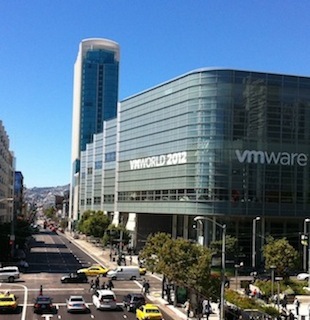
We discussed last year’s vSphere 5 storage changes in a previous post.  And at last week’s VMworld2012 in San Francisco, VMware announced a few new enhancements for vSphere 5.1 but showed more on their vision for the future of storage in VMware environments.

vSphere 5.1 storage enhancements were not as significant as last year’s enhancements.  Specifically, vSphere 5.1 storage oriented changes include:

  • VDP – vSphere Data Protector is a new agentless, deduplicating backup solution from VMware (and EMC) which is now bundled into vSphere and comes free for all users at the Essentials+ level and above. VDP is based on EMC’s Avamar Virtual Edition and provides a new integrated data protection management tab in vCenter Operations Manager GUI.  VDP replaces VDR.
  • vMotion changes – vMotion now supports non-shared storage and specifically, VSA storage environments.  To do this vMotion will now perform a standard storage vMotion to the targeted host before the VM vMotion takes place to move the data to the new location.
  • vSphere replication auto-failback with SRM – SRM 5.1 now supports vSphere replication service automated failback. SRM 5 supported storage array based replication automated failback but had no support for the then announced new VMware, host based replication service. This has been rectified with SRM 5.1.
  • SRM packaging changes – SRM standard now comes at no additional charge with the vCloud Suite Standard license option.  And a new entry level SRM (for 6 CPUs, 3 hosts) comes with Essentials+ to match and provide DR services for VSA environments.

VMware storage vision

VMware took the opportunity to discuss their vision for future offerings in the storage arena.  Specifically,

  • vSphere volumes (vVols) –  vVols will become the new defacto standard unit of granularity and abstraction for storage systems, providing a new allocation unit behind VMDKs and eliminating VMFS.  vVols are intended to define a new interface between vSphere and networked storage systems so that VMDKs can now be replicated, snapshot, cloned, etc.  alone without impacting other VMDKs on the storage system.  vVols are intended to replace LUNs and/or files used as previous holding containers for VMDKs.  vVols -should eliminate the mess of having to define 1000s of LUNs required to support VDI or cloud data centers implementations
  • Virtual flash – VMware’s first internal support for server side flash.  VMware will now be able to partition and allocate the flash on PCIe cards to VMs executing in the ESX server just like physical memory and vCPUs are today.  Also VMware will be able to copy flash cache contents when vMotion-ing VMs to other physical servers.  The intent is to fully support PCIe flash cards for vMotion by warm starting the flash in the target server and bring fast access storage closer to VMs.
  • VSAN – also called distributed storage, takes VSA like services and scales it out to support many more hosts/CPUs and networked storage.   The ultimate goal here seems to be to provide a shared, mid-tier, distributed storage system based on VMware DAS, which will better support vSphere execution and high availability.  VSAN will provide compute and storage within the same host.  It’s intended that VSAN be easier to configure, deploy and manage than current VM shared storage solutions.

Where are they going with all this?

I believe VMware is signaling an intent to get more involved in the storage arena.  Last years move with VSA now seems like just the beginning.

If examined together with their other thrusts for the virtual data center, it all starts to make sense. When these three future storage capabilities are in place, VMware should be better able to configure and support virtual cloud data centers (VCD) built out of commodity servers, commodity storage and commodity networking gear.  With all this in place VCDs should be better able to compete with AWS and other cloud service providers.

The end of enterprise storage, …

I was talking with one IT analyst, Dr. Kevin McIsaac with IBRS in Australia who feels when these three capabilities start rolling out, it signals the beginning of the end of enterprise storage as we know it.  He compares  this to what happened to specialized Unix servers (from HP, Sun, IBM, etc.) prominent at the end of the last century and early this century with the introduction of VMware and commodity high-performance, Intel servers/microprocessor chips.  Although these proprietary Unix servers still exist they are no longer growing market share.

In Kevin’s view, VMware is just following that playbook again, only this time it’s enterprise storage in their sights.  Of course, the other side of this is the enterprise networking that starts to be commoditized by all the virtual networking capabilities VMware is rolling out in VxLAN and Nicira integration as well. (Perhaps subject for another post).

… Not quite yet.

I understand his point and can’t help but agree with parts of it at least at the low end and potentially mid-tier storage.  IMHO however, enterprise storage vendors have a viable defense to all this but it involves providing even more functionality, performance and capabilities than they available today in their systems.

I see it every time I look at my performance charts, anytime you start getting over 300 disk drives, storage sophistication matters more to performance, than just throwing more hardware in the mix.  For an example of this effect checkout my last post on SPC-2 performance correlations.

And of course, VMware might be straining their very profitable relationship with storage vendors today such as Dell, HP, IBM, NetApp, EMC, etc. all of which today highlight and push their virtualization solution throughout their partner community.   If they decide to stop recommending VMware and start focusing on other virtualization offerings this might also stall VMware’s vision.

~~~~

In the end I can’t help but feel that in VMware’s view their challenge, in the long run will come from AWS, Google and other cloud service providers. Whatever they can do to better prepare to compete with this gaggle of cloud purveyors, the better they succeed for their enterprise customer. And ultimately that means more business for VMware.  If enterprise networking and storage vendors have to adapt to that vision, then so be it.

Comments?

VMworld first thoughts kickoff session

[Edited for readability. RLL] The drummer band was great at the start but we couldn’t tell if it was real or lipsynched. It turned out that each of the Big VMWORLD letters had a digital drum pad on them which meant it was live, in realtime.

Paul got a standing ovation as he left the stage introducing Pat the new CEO.  With Paul on the stage, there was much discussion of where VMware has come the last four years.  But IDC stats probably say it better than most in 2008 about 25% of Intel X86 apps were virtualized and in 2012 it’s about 60% and and Gartner says that VMware has about 80% of that activity.

Pat got up on stage and it was like nothing’s changed. VMware is still going down the path they believe is best for the world a virtual data center that spans private, on premises equipment and extrenal cloud service providers equipment.

There was much ink on software defined data center which is taking the vSphere world view and incorporating networking, more storage, more infrastructure to the already present virtualized management paradigm.

It’s a bit murky as to what’s changed, what’s acquired functionality and what’s new development but suffice it to say that VMware has been busy once again this year.

A single “monster vm” (has it’s own facebook page) now supports up to 64 vCPUs, 1TB of RAM, and can sustain more than a million IOPS. It seems that this should be enough for most mission critical apps out there today. No statement on latency the IOPS but with a million IOS a second and 64 vCPUs we are probably talking flash somewhere in the storage hierarchy.

Pat mentioned that the vRAM concept is now officially dead. And the pricing model is now based on physical CPUs and sockets. It no longer has a VM or vRAM component to it. Seemed like this got lots of applause.

There are now so many components to vCloud Suite that it’s almost hard to keep track of them all:  vCloud Director, vCloud Orchestrator, vFabric applications director, vCenter Operations Manager, of course vSphere and that’s not counting relatively recent acquisitions Dynamic Op’s a cloud dashboard and Nicira SDN services and I am probably missing some of them.

In addition to all that VMware has been working on Serengeti which is a layer added to vSphere to virtualize Hadoop clusters. In the demo they spun up and down a hadoop cluster with MapReduce operating to process log files.  (I want one of these for my home office environments).

Showed another demo of the vCloud suite in action spinning up a cloud data center and deploying applications to it in real time. Literally it took ~5minutes to start it up until they were deploying applications to it.  It was a bit hard to follow as it was going a lot into the WAN like networking environment configuration of load ballancing, firewalls and other edge security and workload characteristics but it all seemed pretty straightforward and took a short while but configured an actual cloud in minutes.

I missed the last part about social cast but apparently it builds a social network of around VMs?  [Need to listen better next time]

More to follow…


Data hypervisor

(c) 2012 Silverton Consulting, Inc. All rights reserved

With all this talk of software defined networking and server virtualization where does storage virtualization stand.  I blogged about some problems with storage virtualization a week or so ago in my post on Storage Utilization is broke and this post takes it to the next level.  Also I was at a financial analyst conference this week in Vail where I heard Mark Lewis of Tekrocket but formerly of EMC discuss the need for a data hypervisor to provide software defined storage.

I now believe what we really need for true storage virtualization is a renewed focus on data hypervisor functionality.  The data hypervisor would need both a control plane and a data plane in order to function properly.   Ideally the control plane would set up the interface and routing for the data plane hardware and the server and/or backend storage would be none the wiser.

DMs everywhere

I envision a scenario where a customer’s application data is packaged with a data hypervisor which runs on a commodity data switch hardware with data plane and control plane software running on it.  Sort of creating (virtual) data machines or DMs.

All enterprise and nowadays most midrange storage provide most of the functionality of a storage control plane such as defining units of storage, setting up physical to logical storage mapping, incorporating monitoring, and management of the physical storage layer, etc.  So control planes are pervasive in today’s storage but proprietary.

In addition most storage systems have data plane functionality which operates to connect a host IO request to the actual data which resides in backend storage or internal cache.  But again although data planes are everywhere in storage today they are all proprietary to a specific vendor’s storage system.

Data switch needed

But in order to utilize a data hypervisor and create a more general purpose control plane layer, we need a more generic data plane layer that operates on commodity hardware. This is different from today’s SAN storage switches or DCB switches but similar in a some ways.

The functions of the data switch/data plane layer would be to take routing instructions from the control plane layer and direct the server IO request to the proper storage unit using the data plane layer.  Somewhere in this world view, probably at the data plane level it would introduce data protection services like RAID or other erasure coding schemes, point in time copy/clone services and replication services and other advanced storage features needed by enterprise storage today.

Also it would need to provide some automated storage movement across and within tiers of physical storage and it would connect server storage interfaces at the front end to storage interfaces at the backend.  Not unlike SAN or DCB switches but with much more advanced functionality.

Ideally data switch storage interfaces could attach to dedicated JBOD, Flash arrays as well as systems using DAS  storage.  In addition, it would be nice if the data switch could talk to real storage arrays on SAN, IP/SANs or NFS&CIFS/SMB storage systems.

The other thing one would like out of a data switch is support for a universal translator that would map one protocol to another, such as iSCSI to SAS, NFS to FC, or FC to NFS and any other combination, depending on the needs of the server and the storage in the configuration.

Now if the data switch were built on top of commodity x86 hardware and software with the data switch as just a specialized application that would create the underpinnings for a true data hypervisor with a control and data plane that could be independent and use anybody’s storage.

Data hypervisor

Assuming all this were available then we would have true storage virtualization.  With these capabilities, storage could be repurposed on the fly, added to, subtracted from, and in general be a fungible commodity not unlike server processing MIPs under VMware or Hyper-V.

Application data would then needed to be packaged into a data machine which would offer all the host services required to support host data access.  The data hypervisor would handle the linkages required to interface with the control and data layers.

Applications could be configured to utilize available storage at ease and storage could grow,  shrink or move to accommodate the required workload just as easily as VMs can be deployed today.

How we get there

Aside from the VMware, Citrix, Microsoft thrusts towards virtual storage there are plenty of storage virtualization solutions that can control most backend enterprise SAN storage. However, the problem with these solutions is that in general the execute only on a specific vendors hardware and don’t necessarily talk to DAS or JBOD storage.

In addition, not all of the current generation storage virtualization solutions are unified. That is most of these today only talk FC, FCoE or iSCSI and don’t support NFS or CIFS/SMB.

These don’t appear to be insurmountable obstacles and with proper allocation of R&D funding, could all be solved.

However the more problematic is that none of these solutions operate on commodity hardware or commodity software.

The hardware is probably the easiest to deal with. Today many enterprise storage systems are built ontop of x86 processor storage controllers. Albeit sometimes they incorporate specialized packaging for redundancy and high availability.

The harder problem may be commodity software. Although the genesis for a few storage virtualization systems might come from BSD or other “commodity” software operating systems. They have been modified over the years to no longer represent anything that can run on standard off the shelf operating systems.

Then again some storage virtualization systems started out with special home grown hardware and software. As such, converting these over to something more commodity oriented would be a major transition.

But the challenge is how to get there from here and would anyone want to take this on.  The other problem is that the value add that storage vendors supply currently would be somewhat eroded.  Not unlike what happened to proprietary Unix systems with the advent of VMware.

But this will not take place overnight and the company that takes this on and makes a go at it can have a significant software monopoly that would be hard to crack.

Perhaps it will take a startup to do this but I believe the main enterprise storage vendors are best positioned to take this on.

Comments?

NetApp Analyst Summit Customer Panel – how to survive a category 5 tornado

20120621-085224.jpg
NetApp had three of their customer innovation winners come up on stage for a panel discussion with Dave Hitz moderating the discussion. All three had interesting deployments of NetApp storage systems:

  • Andrew Henderson from ING DIRECT talked about their need to deploy copies of the banks IT environment for test, development, optimization and security testing. This process took 12 weeks to accomplish the first time they tried and only created a single copy. They wanted to speed this up and be able to deploy 10 or more copies if necessary. Andrew looked at Microsoft Hyper-V, System Center and NetApp FlexClones and transformed this process to now generate a copy of the entire banks IT services in under 10 minutes. And since the new capabilities have been in place they have created over 400 copies of the bank (he called these bank-in-a-box) for various purposes.
  • Teresa Wahlert from Iowa Workforce Development Agency was up next and talked about their VDI implementation. Iowa cut their budget which forced them to shut down a number of physical offices. But with VDI, VMware and NetApp storage Workforce were able to disperse their services to over 3000 locations now in prisons, libraries, and other venues where they had no presence before. They put out a general call for all the tired, dying PCs in Iowa government and used these to host VDI services. Now Workforce services are up 7X24 locations, pretty amazing for government work. Apparently they had tried VDI before and their previous storage couldn’t handle it. They moved to NetApp with FlashCache and it worked just fine. That’s when they rolled it VDI services to their customers and businesses. With NetApp they were able to implement VDI, reduce storage costs (via deduplication and other storage efficiency features) and increase department services.
  • Jeff Bell at Mercy Healthcare talked about the difficulties of rolling out electronic health records (EHR) and their challenges of integrating ~30 hospitals and ~400 medical clinics. They started with EHR fairly early 2006-2007 well before the latest governmental push. He mentioned Joplin MO and last years category 5 tornado which about wiped out their hospital there. He said within 2 hours after the disaster, Mercy Healthcare was printing out the EHR for the 183 patients present in the hospital at the time that had to be moved to other care facilities. The promise of EHR is that the information travels with the patient, can be recovered in the event of a disaster and is immediately available.  It seems that at least at Mercy Healthcare, EHR is living up to its promise. In addition, they just built a new data center as they were running out of space, power and cooling at the old one. They installed new NetApp storage there and for the first few months had to run heaters to keep the data center live-able because the new power/cooling load was so far below what they were experienced previously. Looking back on what they had accomplished Jeff was not so sure they would build a new data center again. With new cloud offerings coming out and the reduced power/cooling and increased density of NetApp storage they could almost get by without another data center at all.

That’s about it from the customer session.

NetApp execs spent the rest of the day on innovation, mostly at NetApp but also in the IT industry in general.

There was lots of discussion on the new release of Data ONTAP 8.1.1 with its latest cluster mode features.  NetApp positioned it as fulfilling out the transition to  data/storage as an infrastructure that IT has been pushing for the last decade or so.  Following in the grand tradition of what IBM did for computing infrastructure with the 360 and what Cisco and others did for networking infrastructure in the mid 80’s.

Comments?

EMC World 2012 Day 2a – VMware & VMAX

20120522-122518.jpg

VMware’s vision

Paul Maritz CEO of VMware came up and gave his vision for the new transformations impacting the IT  world today. It all starts with infrastructure transformation and VMware’s build out of the cloud infrastructure suite (stack).  Paul described the backend transformation provided by VMware as follows:

  • vSphere – providing virtualization, pooling oand scheduling of resources across multiple physical boundaries,
  • vShield – providing software defined services across net, storage and server resources in the infrastructure,
  • vCloud Director – providing administration, self service and multi-tenancy for physical and virtual resources,
  • vCenter Operations Manager – providing automated monitoring and management of physical and virtual resources,
  • vFabric Data and Application Director(s) – providing app-aware and data (aware?) service provisioning.


20120522-122601.jpgPaul went on to discuss the frontend transformation primarily through VMware View 5.1 and VMware’s Horizon Suite covering any display out there. He finished up talking about application transformation keying on Spring framework, GemFire RAM database, and CloudFoundery.org/.com open source cloud APIs.

20120522-125105.jpg

VMAX enhancements

Brian Gallagher did a keynote on the changes to the VMAX product line, with the new 10K, 20K and 40K storage systems supporting ~1PB, ~2PB and over ~4PB of capacity.

The new systems also support both 2.5″ and 3.5″ drives and will now support eMLC SSDs. Brian talked about the many millions of run hours they now have on FAST VP in enterprises around the world.

He also introduced the VMAX SP, a new storage service offering where EMC owns the equipment and sells storage QOS to the customer with special SLAS associated with the storage.  Brian sees this as a step to increasing IT agility allowing for a quick turnaround deployment of enterprise storage without the high acquisition cost and complexity.

Brian also talked about Federated Storage Tiering where VMAX can now incorporate other vendor storage as a storage tier with VMAX advanced functionality in front of it.

More on VMAX new enhanced hardware and software in our free monthly newsletter (sign up above right).

… more to come.

OpenFlow, the next wave in networking

OpenFlow Logo (from www.OpenFlow.org)
OpenFlow Logo (from http://www.OpenFlow.org)

Read two articles recently about how OpenFlow‘s Software Defined Networking is going to take over the networking world, just like VMware and it’s brethern have taken over the server world.

Essentially, OpenFlow is a network protocol that separates the control management of a networking switch or router (control plane) from it’s data path activities (data plane).  For most current switches, control management consists of vendor supplied,  special purpose software which differs for each and every vendor and sometimes even varies  across vendor product lines.

In contrast, data path activities are fairly similar for most of today’s switches and is generally implemented in custom hardware so as to be lightening fast.

However, the main problem with today’s routers and switches is that there is no standard way to talk or even modify the control management software to modify it’s data plane activities.

OpenFlow to the rescue

OpenFlow changes all that. First it specifies a protocol or interface between a switches control plane and it’s data plane.  This allows that control plane to run on any server and still provide management for a router or switch data path activities.  By doing this OpenFlow provides Software Defined Networking (SDN).

Once OpenFlow switches and control software are in place, the SDN can better control and manage networking activity to optimize for performance, utilization or any other number of parameters.

Products are starting to come out which support OpenFlow protocols.  For example, a new OpenFlow compatible ethernet switch is available from IBM (their RackSwitch G8264 & G8264T) and HP has recently released OpenFlow software for their ethernet switches (see OpenFlow blog post).  At least some in the industry are starting to see the light.

Google implements OpenFlow

The surprising thing is that one article I read recently is about Google running an OpenFlow network on it’s data center backbone (see Wired’s Google goes with the Flow article).   In the article it discusses how a top Google scientist talked about how they implemented OpenFlow for their internal network architecture at the Open Networking Summit yesterday.

Google’s internal network connects it’s multiple data centers together to provide Google Apps and other web services.  Apparently, Google has been secretly creating/buying OpenFlow networking equipment and creating it’s own OpenFlow software. This new SDN they have constructed has given them the ability to change their internal network backbone in minutes which would have taken days, weeks or even months before. Also, OpenFlow has given Google the ability to simulate network changes ahead of time allowing them to see what potential changes will do for them.

One key metric is that Google now runs their backbone network close to 100% utilized at all times whereas before they worked hard to get it to 30-40% utilization.

Nicira revolutionizes networking

The other article I read was about a startup called Nicira out of Palo Alto, CA which is taking OpenFlow to the next level by defining a Network Virtual Platform (NVP) and Open vSwitches (OVS).

  • A NVP  is a network virtualization platform controller which consists of cluster of x86 servers running the network virtualization control software providing a RESTful web services API and defines/manages virtual networks.
  • An OVS is an Open vSwitch software designed for remote control that either runs as a complete software only service in various hypervisors or as gateway software connecting VLANs running on proprietary vendor hardware to the SDN.

OVS gateway services can be used with current generation switches/routers or be used with high performing, simple L3 switches specifically designed for OpenFlow management.

Nonetheless, with NVP and OVS deployed over your networking hardware it removes many of the limitations inherent in current networking services.  For example, Nicira network virtualization, allows the movement of application workloads across subnets while maintaining L2 adjacency, scalable multi-tenant isolation and the ability to repurpose physical infrastrucuture on demand.

By virtualizing the network, the network switching/router hardware becomes a pool of IP-switching services, available to be repurposed and/or reprogrammed at a moments notice.  Not unlike what VMware did with servers through virtualization.

Customers for Nicira include eBay, RackSpace and AT&T to name just a few.  It seems that networking virtualization is especially valuable to big web services and cloud services companies.

~~~~

Virtualization takes on another industry, this time networking and changes it forever.

We really need something like OpenFlow for storage.  Taking storage administration out of the vendor hands and placing it elsewhere.  Defining an open storage management protocol that all storage vendors would honor.

The main problem with storage virtualization today is it’s kind of like VLANs, all vendor specific.   Without, something like a standard protocol, that proscribes a storage management plane’s capabilities and a storage data plane’s capabilities we can not really have storage virtualization.

One day with HDS

HDS CEO Jack Domme shares the company’s vision and strategy with Influencer Summit attendees #HDSday by HDScorp

Attended #HDSday yesterday in San Jose.  Listened to what seemed like the majority of the executive team. The festivities were MCed by Asim Zaheer, VP Corp and Product Marketing, a long time friend and employee, that came to HDS with the acquisition of Archivas five or so years ago.   Some highlights of the day’s sessions are included below.

The first presenter was Jack Domme, HDS CEO, and his message was that there is a new, more aggressive HDS, focused on executing and growing the business.

Jack said there will be almost a half a ZB by 2015 and ~80% of that will be unstructured data.  HDS firmly believes that much of this growing body of  data today lives in silos, locked into application environments and can’t become truly information until it can be liberated from this box.  Getting information out of the unstructured data is one of the key problems facing the IT industry.

To that end, Jack talked about the three clouds appearing on the horizon:

  • infrastructure cloud – cloud as we know and love it today where infrastructure services can be paid for on a per use basis, where data and applications move seemlessly across various infrastructural boundaries.
  • content cloud – this is somewhat new but here we take on the governance, analytics and management of the millions to billions pieces of content using the infrastructure cloud as a basic service.
  • information cloud – the end game, where any and all data streams can be analyzed in real time to provide information and insight to the business.

Jack mentioned the example of when Japan had their earthquake earlier this year they automatically stopped all the trains operating in the country to prevent further injury and accidents, until they could assess the extent of track damage.  Now this was a specialized example in a narrow vertical but the idea is that the information cloud does that sort of real-time analysis of data streaming in all the time.

For much of the rest of the day the executive team filled out the details that surrounded Jack’s talk.

For example Randy DeMont, Executive VP & GM Global Sales, Services and Support talked about the new, more focused sales team. On that has moved to concentrate on better opportunities and expanded to take on new verticals/new emerging markets.

Then Brian Householder, SVP WW Marketing and Business Development got up and talked about some of the key drivers to their growth:

  • Current economic climate has everyone doing more with less.  Hitachi VSP and storage virtualization is a unique position to be able to obtain more value out of current assets, not a rip and replace strategy.  With VSP one layers better management on top of your current infrastructure, that helps get more done with the same equipment.
  • Focus on the channel and verticals are starting to pay off.  More than 50% of HDS revenues now come from indirect channels.  Also, healthcare and life sciences are starting to emerge as a crucial vertical for HDS.
  • Scaleability of their storage solutions is significant. Used to be a PB was a good sized data center but these days we are starting to talk about multiple PBs and even much more.  I think earlier Jack mentioned that in the next couple of years HDS will see their first 1EB customer.

Mark Mike Gustafson,  SVP & GM NAS (former CEO BlueArc) got up and talked about the long and significant partnership between the two companies regarding their HNAS product.  He mentioned that ~30% of BlueArc’s revenue came from HDS.  He also talked about some of the verticals that BlueArc had done well in such as eDiscovery and Media and Entertainment.  Now these verticals will become new focus areas for HDS storage as well.

John Mansfield, SVP Global Solutions Strategy and Developmentcame up and talked about the successes they have had in the product arena.  Apparently they have over 2000 VSPs intsalled, (announced just a year ago), and over 50% of the new systems are going in with virtualization. When asked later what has led to the acceleration in virtualization adoption, the consensus view was that server virtualization and in general, doing more with less (storage efficiency) were driving increased use of this capability.

Hicham Abdessamad, SVP, Global Services got up and talked about what has been happening in the services end of the business.  Apparently there has been a serious shift in HDS services revenue stream from break fix over to professional services (PS).  Such service offerings now include taking over customer data center infrastructure and leasing it back to the customer at a monthly fee.   Hicham re-iterated that ~68% of all IT initiatives fail, while 44% of those that succeed are completed over time and/or over budget.  HDS is providing professional services to help turn this around.  His main problem is finding experienced personnel to help deliver these services.

After this there was a Q&A panel of John Mansfield’s team, Roberto Bassilio, VP Storage Platforms and Product Management, Sean Moser,  VP Software Products, and Scan Putegnat, VP File and Content Services, CME.  There were a number of questions one of which was on the floods in Thailand and their impact on HDS’s business.

Apparently, the flood problems are causing supply disruptions in the consumer end of the drive market and are not having serious repercussions for their enterprise customers. But they did mention that they were nudging customers to purchase the right form factor (LFF?) disk drives while the supply problems work themselves out.

Also, there was some indication that HDS would be going after more SSD and/or NAND flash capabilities similar to other major vendors in their space. But there was no clarification of when or exactly what they would be doing.

After lunch the GMs of all the Geographic regions around the globe got up and talked about how they were doing in their particular arena.

  • Jeff Henry, SVP &GM Americas talked about their success in the F500 and some of the emerging markets in Latin America.  In fact, they have been so successful in Brazil, they had to split the country into two regions.
  • Niels Svenningsen, SVP&GM EMAE talked about the emerging markets in his area of the globe, primarily eastern Europe, Russia and Africa. He mentioned that many believe Africa will be the next area to take off like Asia did in the last couple of decades of last century.  Apparently there are a Billion people in Africa today.
  • Kevin Eggleston, SVP&GM APAC, talked about the high rate of server and storage virtualization, the explosive growth and heavy adoption of Cloud pay as you go services. His major growth areas were India and China.

The rest of the afternoon was NDA presentations on future roadmap items.

—-

All in all a good overview of HDS’s business over the past couple of quarters and their vision for tomorrow.  It was a long day and there was probably more than I could absorb in the time we had together.

Comments?